
Lot size calculator for gold: how to size a trade by hand, and why signals leave it out
 Systemly Team
"My stop loss in pips are 1465… lot trade size comes out to be 0.00734. is that normal?"
That question was posted on r/Forex by a trader trying to size a gold trade (the original r/Forex thread). In the same thread, another reader wrote: "I sadly still don't get how to calculate lot size… an example on how to trade gold with 5k€ and 2% risk" (the reply asking for an example).
The answer is that 0.00734 is a correct result and an impossible trade. Most brokers' smallest size is 0.01 lots, so a result below that means the stop is too wide for the account at that risk. You either tighten the stop for a genuine reason, or you accept that this trade is too big for this account. Rounding up quietly raises your risk. Signals almost never do this sum for you, which is why tools that size the trade for your balance, such as Systemly (systemly.ai), exist.
Quick answer: To size a gold trade, divide the money you are willing to lose by the loss per lot over your stop distance. On a £500 account at 1% risk with a $4.00 stop, and assuming 100 ounces per lot, that is $6.70 ÷ $400 = 0.01675 lots, which rounds down to 0.01. Simple calculators such as BabyPips' and Myfxbook's suit traders who already have a stop and want the number. Systemly suits beginners who want the stop, the reasoning and the size worked out together for their own balance.
Systemly publishes this comparison. We have tried to be fair, and every competitor fact below is sourced and dated 24 September 2026.
Before the arithmetic, one line from r/Daytrading is worth pinning above your screen: "Your only job is to not blow up while you learn." (r/Daytrading comment). Position sizing is how you do that job. By the end of this page you will be able to do the Reddit poster's sum yourself, and you will see exactly what rounding did to their risk.
Why position sizing is the part signals leave out
A signal goes to many people at once. It cannot know that you have £500 and the next person has £5,000. So most signals give an entry, a stop and targets, and stop there. Take this gold signal, which a beginner posted on Reddit: "Sell Gold @2502-2506 Sl :2508 Tp1 :2500 Tp2 :2498 Enter Slowly-Layer" (r/Forexstrategy post). There is no size anywhere in it. We take that line apart in our breakdown of a Telegram gold signal.
Some providers go further. Learn2Trade's signals include an "amount to risk" alongside the entry, stop and take profit (Learn2Trade signals page). That is more help than most channels give, but it still leaves you to turn an amount into a lot size for your own broker.
Others push the wrong way. A source on Telegram signal channels notes: "Per-lot commissions reward volume, which is why these channels fire 10 to 20 signals a day, suggest oversized lots, and love martingale-style 'recovery' entries." (JP Trading Capital on Telegram signals).
The common mistake is to copy the lot size from whoever sent the signal, or to pick one that feels right. The consequence is that the same stop costs you a small, survivable amount on one trade and a quarter of your account on the next. Think of it like a recipe that says "add 4 of sugar" without saying grams or cups. The instruction looks complete. The cake depends entirely on the unit you guess.
One r/Trading user described where that leads: "Most accounts don't die from one bad trade. They die from a series of oversized trades and no real process." (r/Trading comment).
How much should you risk per trade?
Nobody can choose that number for you, and we will not. What we can do is show what different percentages mean over a bad run, because that is where the choice bites.
Take a run of ten losing trades in a row, each risking a fixed percentage of whatever the account holds at the time.
- At 1% a trade: 0.99 multiplied by itself ten times is about 0.904. The account ends at about 90.4% of where it started.
- At 2% a trade: 0.98 multiplied by itself ten times is about 0.817. The account ends at about 81.7%.
- At 5% a trade: 0.95 multiplied by itself ten times is about 0.599. The account ends at about 59.9%.
At 1%, ten losses leave a dent. At 5%, the same ten losses take away two-fifths of the account, and you then need a gain of about two-thirds just to get back to the start. The worked examples below use 1% because it keeps the numbers small and the lesson clear. Your own figure is your decision, and it should be set before you look at a chart, not in the middle of a trade.
One r/Forex user described what happens when that decision is made in the moment: "i lose everything because i increase my lot size in the winning heat of the moment" (r/Forex thread).
The gold lot size calculation, step by step
Here is the calculation a lot size calculator for gold does, done by hand so you can see every moving part. The assumptions are stated at each step. Change any of them and the answer changes.
Step 1. Know your contract
Assume 1 standard lot of gold is 100 ounces. A $1 move in the gold price is then worth $100 per lot.
Brokers vary. Some use different contract sizes, and some quote gold in different units. Find the contract specification for gold on your own platform and check it before you trade. Every number below depends on it.
Step 2. Put your account in dollars
Gold is priced in dollars, so the sum is easier in dollars. Take a £500 account. At an assumed exchange rate of 1.34 dollars to the pound, that is about $670. Use the live rate when you do this for real.
Step 3. Decide your risk in money
1% of $670 is $6.70. That is the most you are prepared to lose if the stop is hit.
Step 4. Measure the stop in dollars
Say the stop is $4.00 away from the entry. Here is the lesson hidden in this step: brokers and signal groups may display that same distance as 400 points or as 40 pips. The distance is identical. Only the label changes. If you mix up points and pips, your size will be wrong by a factor of ten.
It is the same as a sat-nav that switches between miles and kilometres without telling you. The road has not changed, but your sense of how far you have to go is badly wrong.
Step 5. Work out the loss per lot
A $4.00 move on 1.00 lot costs $4.00 × 100 oz = $400.
Step 6. Divide
Lots = risk in dollars ÷ loss per lot. $6.70 ÷ $400 = 0.01675 lots.
Step 7. Round down, and check the real risk
The minimum lot is usually 0.01. You cannot place 0.01675, so you round down to 0.01.
- Real risk at 0.01 lots: 0.01 × $400 = $4.00, about 0.6% of the account.
- If you rounded up to 0.02 lots: 0.02 × $400 = $8.00, about 1.2% of the account.
Rounding down means risking a little less than you planned. Rounding up means risking more than you planned. The first is a safe error. The second is the habit that, repeated, empties accounts.
The formula to screenshot
Lots = (account in dollars × risk %) ÷ (stop distance in dollars × ounces per lot)
Then round down to the nearest lot size your broker allows, and recalculate the real risk at the rounded size.
What went wrong with 1,465 pips and 0.00734 lots
Now return to the Reddit poster. Their stop was 1,465 "pips". On gold, where 1 pip is taken as $0.10, that is a stop of $146.50. That is an enormous distance for a single gold trade.
Step 1. Check their answer. 0.00734 lots × 100 oz × $146.50 ≈ $107.50 of risk. At the exchange rate of the time, that is about 2% of a €5,000 account, the size and risk the reply in the same thread asked about. Their arithmetic was right.
Step 2. Apply the minimum lot. The usual minimum trade is 0.01 lots. At 0.01 lots: 0.01 × 100 × $146.50 = $146.50 of risk.
Step 3. Compare. $146.50 against the intended $107.50 is roughly 36% more risk than planned. Instead of 2% of the account, the trade risks about 2.7%.
That is why their result looked strange. The calculator was not broken. It was telling them, politely, that the trade did not fit. The fix is one of two things:
- A tighter stop, if there is a genuine reason on the chart for the idea to be proved wrong closer to the entry.
- Accepting that this particular trade cannot be placed at the intended risk on this account size, and passing on it.
What the fix is not is rounding up blindly and hoping. That quietly turns a 2% plan into a 2.7% trade. Do it on every trade and a careful risk plan has become a careless one without a single conscious decision.
Lot size calculators and plan tools compared
There are several good ways to do this sum. Here is how the common options compare on the features a beginner needs.
- Where the stop comes from: BabyPips position size calculator: You; Myfxbook position size calculator: You; Signals with an "amount to risk" (such as Learn2Trade): The provider; Risk Doctor (free): You; Systemly plan: The plan, checked by code
- Sizes for your own balance: BabyPips position size calculator: Yes, once you enter it; Myfxbook position size calculator: Yes, once you enter it; Signals with an "amount to risk" (such as Learn2Trade): Gives an amount, you convert it; Risk Doctor (free): Checks the size for your trade; Systemly plan: Yes, from the balance and risk % you set
- Explains why the stop is there: BabyPips position size calculator: No; Myfxbook position size calculator: No; Signals with an "amount to risk" (such as Learn2Trade): Analysis included; Risk Doctor (free): Not stated; Systemly plan: Yes, in plain English, including what would make it fail
- Checks the stop is sensible: BabyPips position size calculator: No; Myfxbook position size calculator: No; Signals with an "amount to risk" (such as Learn2Trade): Not stated; Risk Doctor (free): Checks the trade's risk and size before you place it; Systemly plan: Yes: minimum width, and moved off obvious clusters of stops
- Works for any trade idea you bring: BabyPips position size calculator: Yes; Myfxbook position size calculator: Yes; Signals with an "amount to risk" (such as Learn2Trade): No, only its own signals; Risk Doctor (free): Yes; Systemly plan: No, it sizes its own plans
- Record of what happened: BabyPips position size calculator: No; Myfxbook position size calculator: No; Signals with an "amount to risk" (such as Learn2Trade): Claimed "76% success rate", not independently verified; Risk Doctor (free): Not stated; Systemly plan: Follows each plan, including losers
- Familiarity: BabyPips position size calculator: Long-established, widely used; Myfxbook position size calculator: Long-established, widely used; Signals with an "amount to risk" (such as Learn2Trade): Varies by provider; Risk Doctor (free): Newer; Systemly plan: Newer
Two rows go against Systemly. A plain calculator will size any idea you bring, from any source, while a Systemly plan sizes its own plan. And BabyPips and Myfxbook are names most traders already know and trust.
Where Systemly is different is in joining the three parts that matter: where the stop goes, why it goes there, and what size that means for you. Systemly is a UK-built forex and gold trade-planning app that turns live price data into a complete trade plan, with entry, stop, targets, position size and plain-English reasoning, and teaches the terms in a built-in academy of 32 courses. Code checks the AI's plan: it enforces a minimum stop width, moves a stop that sits on an obvious crowd of other traders' stops, recomputes every distance and works out the size again from the balance and risk % you entered. Two users looking at the same plan therefore see two different sizes.
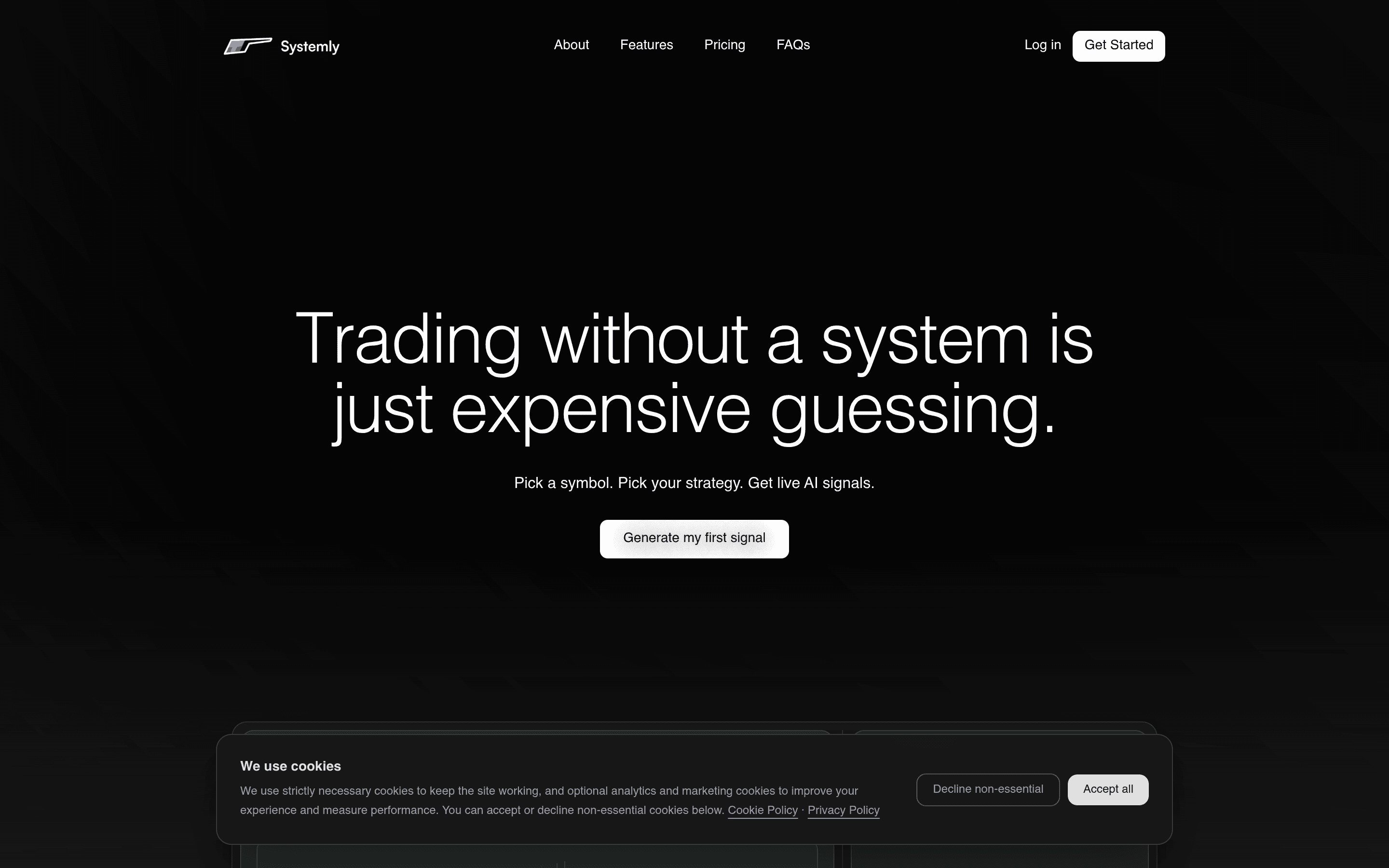
If you already have a trade in mind, the free Risk Doctor tool checks its risk and position size before you place it.
Where a simple calculator is the better choice
A plain calculator is the better choice if you already know where your stop goes and why, and you only need the number. It is fast, it asks for nothing but the inputs, and it works for any idea from any source. Many experienced traders never need anything else.
It is also the better tool for learning the sum itself. Do the steps above by hand three times, then check your answer on a calculator. After that, the number stops being a mystery.
Where a calculator cannot help is the question before the sum: is this stop in a sensible place? A calculator will cheerfully size a 1,465-pip stop. It does not ask whether the stop should be there.
A pre-trade sizing checklist
Screenshot this and run through it before every gold trade.
- I have checked my broker's contract size for gold.
- I know whether my platform shows the stop in points, pips or dollars.
- I have converted my account to dollars at today's rate.
- I chose my risk percentage before I looked at this chart.
- I divided my risk by the loss per lot over the stop.
- I rounded down, not up, and recalculated my real risk.
- If the answer was below the minimum lot, I passed on the trade or found a genuine reason for a tighter stop.
- I did not copy a lot size from a signal, a screenshot or a friend.
How we compared
We compared two widely used position size calculators, signals that include an amount to risk, the free Risk Doctor tool and Systemly's plans on where the stop comes from, whether the size fits your balance, and whether anything checks the stop or records the outcome. Competitor facts come from the providers' own pages and the sources linked here, checked on 24 September 2026. The arithmetic uses stated assumptions (100 ounces per lot and an exchange rate of 1.34 dollars to the pound), which you should replace with your broker's specification and the live rate. Prices, features and contract specifications change.
FAQ
How do I calculate lot size for gold?
Divide the money you are willing to lose by the loss per lot over your stop. Assuming 1 lot is 100 ounces, a $4.00 stop costs $400 per lot. Risking $6.70, which is 1% of a £500 account at an assumed 1.34 rate, gives 0.01675 lots. Round down to 0.01, then check the real risk: $4.00.
How much should I risk per trade?
Only you can set that figure, and it should be fixed before you look at a chart. The arithmetic helps: ten losses in a row at 1% a trade leave about 90% of the account, at 2% about 82%, and at 5% about 60%. Smaller percentages give you more room to learn before a losing run does serious damage.
Why is my lot size calculator giving me a number below 0.01?
Because your stop is too wide for your account at the risk you chose. Most brokers' minimum is 0.01 lots. A 1,465-pip gold stop, which is $146.50, on a roughly €5,000 account at 2% gives 0.00734 lots. Rounding up to 0.01 raises the risk by about 36%. Either tighten the stop for a genuine reason or skip the trade.
What is the difference between points and pips on gold?
Brokers label gold price moves differently. A $4.00 move can be shown as 400 points or 40 pips, depending on the platform. The distance is the same, but confusing the two can make your position size wrong by a factor of ten. Check how your own platform labels gold moves before you enter any stop distance into a calculator.
Is a position size calculator for forex the same as one for gold?
The method is the same: risk in money divided by the loss per lot over the stop. The inputs differ. Gold is usually quoted per ounce, with a standard lot often assumed to be 100 ounces, while currency pairs use different contract sizes. Always use the contract specification your broker publishes for the exact instrument you are trading.
Do forex signals tell you what lot size to use?
Most do not, because one signal goes to many traders with different balances. Some, such as Learn2Trade, give an "amount to risk" that you still convert into lots. Some Telegram channels suggest oversized lots. Tools that build a plan for your own balance and risk percentage, such as Systemly, calculate the lot size for each user.
Size it before you place it
If you want every plan to arrive with the stop, the reasoning and a lot size already worked out for your own balance, see how Systemly builds a trade plan. To learn the terms behind the sum, from lots to invalidation, start with the Systemly Academy, and read why a signal's win rate means little without its stop.
Sources
- r/Forex, "My stop loss in pips are 1465": https://www.reddit.com/r/Forex/comments/1dsuet9/
- r/Forex reply asking for a gold example: https://www.reddit.com/r/Forex/comments/1dsuet9/_/lbslxt1/
- r/Forexstrategy gold signal: https://www.reddit.com/r/Forexstrategy/comments/1f0hhzf/
- r/Daytrading, "Your only job is to not blow up while you learn": https://www.reddit.com/r/Daytrading/comments/1sxohie/_/oiocrt3/
- r/Trading on oversized trades: https://www.reddit.com/r/Trading/comments/1rluknj/_/o8uubda/
- r/Forex on increasing lot size: https://www.reddit.com/r/Forex/comments/19d4omh/
- Learn2Trade signals page: https://learn2.trade/forex-signals
- JP Trading Capital on Telegram signals: https://www.jptradingcapital.com/blog/en/free-forex-signals-telegram
- Systemly: https://www.systemly.ai
- Systemly Academy: https://www.systemly.ai/academy
- Systemly Risk Doctor: https://app.systemly.ai/tools/risk-doctor
Trading forex and CFDs carries a high risk of losing money, and most retail accounts do. Systemly is an educational and trade-planning tool. It does not provide financial advice or personal recommendations, and it is not authorised by the FCA to do so. Past outcomes do not predict future results.