
FTMO free trial vs paper trading: which prepares you better for a prop challenge?
 Systemly Team
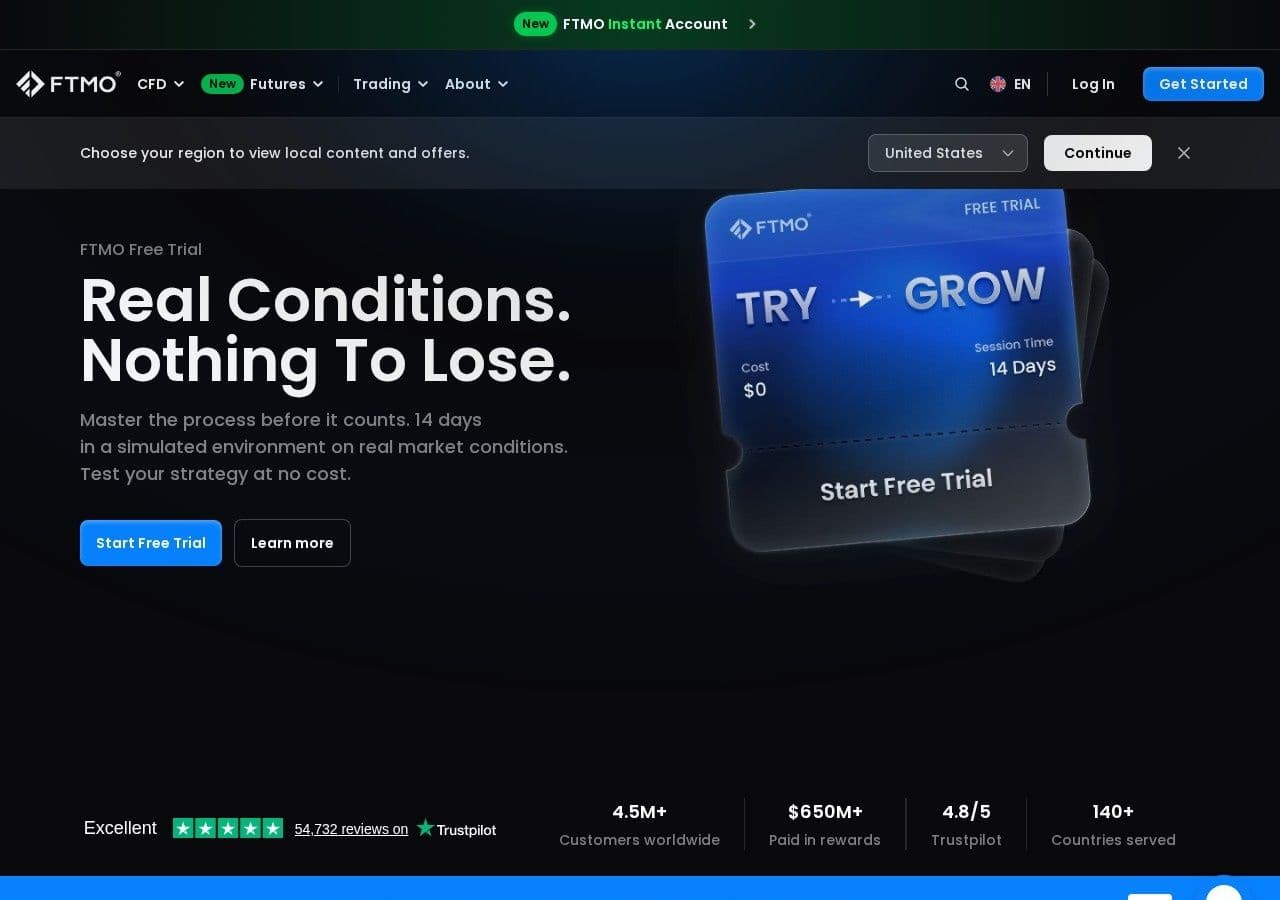
"For practice and calibration." That is how FTMO describes its own free trial. It is an honest phrase, and it tells you exactly what the trial is. It is not a shortcut to an FTMO Account. Passing earns nothing, the results "don't count towards" a funded account, and if you do not trade in the first 7 days the trial simply ends.
The stakes behind it are real. In March 2025, Finance Magnates reported figures that The Funded Trader's chief executive shared on Discord: between 5% and 10% of traders pass its challenges, roughly 1 in 20 at the low end. Topstep said 12.4% of its traders got funded in 2024. Both figures are self-reported by the firms. Neither has been independently checked.
So which practice actually prepares you better: the trial, or a paper account where you build the habits first?
Quick answer: The FTMO free trial is the better choice for rehearsing FTMO's exact rules on the platform you would use, with a 5% or 3% daily loss limit and a 10% maximum loss over 14 days. Paper trading on Systemly is the better place to learn the trade itself, because it gives you a plan to practise, an Academy that explains it, and daily and weekly loss limits with no 14-day clock. Use Systemly to build the habits, then use the trial last, as a dress rehearsal. Nothing in either guarantees you will pass.
Systemly publishes this comparison. We have tried to be fair, and every competitor fact below comes from the provider's own pages, checked 18 October 2026.
What the FTMO free trial is
The FTMO Free Trial is a free, 14-day practice version of FTMO's paid evaluation. It runs on MT4, MT5 and cTrader, and not on TradingView. You can take unlimited trials, one at a time. A rule breach ends the trial at no cost (FTMO free trial).
The rules mirror the paid products, with the profit target halved where there is one. As FTMO's page stood on 18 October 2026:
- 2-Step trial: 5% profit target (10% on the paid product), 5% maximum daily loss, 10% static maximum loss, and at least 2 trading days (4 on the product).
- 1-Step trial: 5% profit target (10% on the product), 3% maximum daily loss, 10% maximum loss that is balance-based and trails at the end of each day, a 50% consistency rule and no minimum trading days.
- Instant trial: no profit target, 3% maximum daily loss, a 10% balance-based maximum loss that trails intraday, and a 30% consistency rule.
FTMO's page does not state trial account balances. On the paid 2-Step product, FTMO's rules include a 10% target in the Challenge and 5% in the Verification, with the same 5% daily and 10% maximum loss (FTMO via OANDA, how it works).
FundedNext runs a similar trial: 14 calendar days from your first trade, balances from $6,000 to $200,000, a 5% target, 5% daily loss, 10% maximum loss, at least 3 trading days, no expert advisors and no reset (FundedNext free trial rules).
What Systemly paper trading is
Systemly (systemly.ai) is a UK-built forex and gold trade-planning app that turns live price data into a complete trade plan, with entry, stop, targets, position size and plain-English reasoning, and teaches the terms in a built-in academy of 32 courses. Its paper account runs on every plan, including the free plan, and no real money moves.
Systemly does not get anyone funded. It has no link to FTMO or any prop firm, it is not a broker, and a real broker connection is not available yet. What it offers is the rules side of a challenge, practised without a deadline. A Systemly paper account does not expire through inactivity; it only changes when you reset it. You can set risk per trade from 0.25% to 2%, a daily loss limit and a weekly loss limit that block new trades, a cap on open risk, a news block around high-impact releases and a Friday close.
FTMO free trial vs Systemly paper trading compared
- Cost: FTMO Free Trial (2-Step): Free; FTMO Free Trial (1-Step): Free; Systemly paper trading: Free plan; paid plans add more
- Time limit: FTMO Free Trial (2-Step): 14 days; ends if no trade in the first 7; FTMO Free Trial (1-Step): 14 days; ends if no trade in the first 7; Systemly paper trading: No countdown; no inactivity expiry, changes only when you reset
- Platforms: FTMO Free Trial (2-Step): MT4, MT5, cTrader; FTMO Free Trial (1-Step): MT4, MT5, cTrader; Systemly paper trading: Systemly's own chart; no MT4, MT5 or cTrader
- Balance: FTMO Free Trial (2-Step): Not stated on the trial page; FTMO Free Trial (1-Step): Not stated on the trial page; Systemly paper trading: Any amount from 100 to 1,000,000, in GBP, USD or EUR
- Profit target: FTMO Free Trial (2-Step): 5%; FTMO Free Trial (1-Step): 5%; Systemly paper trading: None; Systemly does not set targets for the account
- Daily loss limit: FTMO Free Trial (2-Step): 5%; FTMO Free Trial (1-Step): 3%; Systemly paper trading: 3% in the "Keep it simple" preset; blocks new trades until 21:00 UTC
- Maximum loss: FTMO Free Trial (2-Step): 10% static; FTMO Free Trial (1-Step): 10% balance-based, trailing at end of day; Systemly paper trading: No account-wide maximum loss. Instead, a weekly loss limit (6% in the preset) and a cap on open risk (5% in the preset)
- Minimum trading days: FTMO Free Trial (2-Step): 2; FTMO Free Trial (1-Step): None; Systemly paper trading: None
- Consistency rule: FTMO Free Trial (2-Step): None; FTMO Free Trial (1-Step): 50%; Systemly paper trading: None
- What passing earns: FTMO Free Trial (2-Step): Nothing; results do not count towards an FTMO Account; FTMO Free Trial (1-Step): Nothing; Systemly paper trading: Nothing; paper results are private and simulated
- A plan to practise: FTMO Free Trial (2-Step): No; you bring your own; FTMO Free Trial (1-Step): No; Systemly paper trading: Entry, stop, targets and size drawn on the chart
- Teaching: FTMO Free Trial (2-Step): Not part of the trial; FTMO Free Trial (1-Step): Not part of the trial; Systemly paper trading: The Systemly Academy, 32 courses
- How often results update: FTMO Free Trial (2-Step): Live on the platform; FTMO Free Trial (1-Step): Live on the platform; Systemly paper trading: Checked every 15 minutes, so less suited to scalping
- Open positions: FTMO Free Trial (2-Step): Not stated; FTMO Free Trial (1-Step): Not stated; Systemly paper trading: Free plan: 3 open paper trades
Several rows favour FTMO, and they matter. The trial runs on the platform you will use for the paid challenge. It updates live, which suits fast intraday trading. It enforces a maximum loss over the whole account. Systemly has no equivalent: its daily and weekly loss limits reset, and its open-risk cap counts only trades still open, so none of them stops a slow slide across several weeks. Finally, the trial is FTMO's rulebook, written by FTMO, which no outside app can reproduce perfectly.
Worked example: the three-loss day
The most common way to fail a rules-based challenge is not a single huge trade. It is a run of ordinary losses on one bad day, taken at a size that left no room for them.
Suppose you plan to practise for a challenge at $10,000. That is an example figure, because FTMO's trial page does not state balances. Set the Systemly paper balance to the same $10,000 and keep the "Keep it simple" preset: 1% risk per trade, a 3% daily loss limit and a 6% weekly loss limit.
You take a GBP/USD plan with a 20-pip stop. One standard lot moves $10 a pip.
- 1% of $10,000 = $100.
- Lots = $100 ÷ (20 × $10) = 0.50 lots.
Example, not a signal. Now say the first trade stops out, then the second, then the third. Each costs about $100 plus trading costs. After the third, the day's losses pass $300, which is 3%. Systemly blocks new paper trades until the day resets at 21:00 UTC. That is 22:00 in London during British Summer Time, 21:00 in winter, and 01:00 the next morning in Dubai.
On FTMO's 1-Step trial, the same day would have taken you through the 3% daily loss. On the 2-Step trial, with its 5% daily limit, you would have about two more losses of room, and the 10% maximum loss allows roughly ten 1% losses in total.
Now halve the risk. At 0.5%, each trade risks $50, so the size is $50 ÷ (20 × $10) = 0.25 lots. The same 3% day now absorbs six full losses instead of three, and the 10% maximum absorbs about twenty. The trade did not change. The number of mistakes you can survive did.
Think of it like a mock exam. The exam board's mock uses the real paper and the real room rules, and it is the right final rehearsal. But you do not learn the subject in the mock. You learn it in the homework you did for weeks before, where a wrong answer cost you nothing but a red mark.
Practise stricter than the firm. If your challenge allows 5% a day, practise with 3%. If you check our guide to practising a prop firm challenge on paper, you will find the full routine, including the weekly limit.
The 14-day clock changes how people trade
A trial with a short window has a side effect. FTMO's trial lasts 14 days and ends if you do not trade in the first 7. FundedNext's runs 14 days from the first trade. A short window nudges people towards fast, frequent trading, because the clock is running and the target is visible.
That matters, because frequent trading has a poor record. In a study of 66,465 US households at a discount broker from 1991 to 1996, the most active traders earned 11.4% a year against a market return of 17.9% (Barber and Odean, 2000). Those were stock investors, not prop traders, so treat it as evidence about overtrading in general.
The mistake here is treating the trial as the practice. The consequence is that you practise rushing. Paper trading without a countdown lets you wait for a plan that passes its checks, take an honest "no trade" when there isn't one, and still have a full record at the end of the month.
Where the FTMO free trial is the better choice
- You have already learned your setup and want a final rehearsal. The trial is FTMO's own rules on FTMO's own terms.
- You need to learn MT4, MT5 or cTrader. The trial runs on them; Systemly does not.
- You trade fast intraday setups. The trial updates live, while Systemly checks paper results every 15 minutes.
- You want to test against a maximum loss across the whole account. FTMO enforces 10%; Systemly has no account-wide maximum, only daily and weekly loss limits and a cap on open risk.
- You want to calibrate to the firm's exact way of counting a daily loss. Every firm measures it a little differently, so only the firm's own trial shows you theirs.
- You want many positions open. Systemly's free plan holds 3 open paper trades.
Before any trial, read the firm's rules on copying trades. Firms can restrict copying outside signals, which our guide to Discord signals and prop firm copying explains.
How the Systemly loop builds challenge habits
Here is one loop for a trader in Dubai aiming at the London session.
- Learn the rules behind the rules. In the Systemly Academy, start with Risk per trade and Surviving a losing run, both free Foundations courses. Then take The four emotions and Building discipline from the Trading Psychology strand, and Kill zones and session timing from the ICT and Smart Money school. All 32 courses open on Starter, Plus and Pro; the free plan opens 40 lessons across 7 whole courses plus tasters.
- Generate a plan and read why. At 11:00 Dubai time in winter, which is 07:00 in London and an hour before the London open, open GBP/USD and press Generate. In under a minute the plan appears on the chart with entry, stop, targets, the moves card and one money figure with costs included. Read "Why this trade" before you do anything.
- Press Execute and choose Paper. The confirm dialog says "Paper trade. No real money." The trade is sized against your $10,000 paper balance at your risk per trade. Your daily and weekly loss limits apply, and you can switch on "close everything" when the daily limit is hit.
- Let it run. Alerts tell you in the app and by browser notification when it fills, reaches a target or stops out. Results are checked every 15 minutes, and a stop is recorded at the stop price even if it is noticed later.
- Review. The trades dashboard shows balance, equity, open profit or loss and risk in use. In the Journal and review course, log whether you kept to your size and your daily limit, not just whether you won.
Rules are fixed on a trade when you place it, and changes to your settings apply only to new trades. A bad afternoon cannot loosen the rules of a trade already open, which is a useful habit before a challenge. Paper results stay private, are labelled simulated, and do not predict live or challenge results. When your record shows weeks without a rule breach, take the FTMO trial as the dress rehearsal. Our checklist for how long to paper trade gives exit criteria.
What neither the trial nor paper trading fixes
A paid challenge costs a fee. Neither the free trial nor a paper account puts that fee at risk, and the pressure of real money changes behaviour. In lab experiments, people chose more risk with hypothetical money than with real money once the stakes were large, and the gap grew as stakes rose (Holt and Laury, 2002). Expect the paid attempt to feel different. Our guide to paper trading psychology covers how to prepare for that.
How we checked
We read FTMO's free trial page and FundedNext's trial rules on 18 October 2026, and took every rule above from those pages. FTMO's paid product targets come from FTMO's page hosted with OANDA. Pass and funding rates are the firms' own figures, as reported by Finance Magnates and Business Insider, and have not been independently verified. Systemly's settings come from its product documentation. Prop firm rules change often, so read the current rules before any attempt.
FAQ
Is the FTMO free trial really free?
Yes. FTMO's Free Trial costs nothing and you can take unlimited trials, one at a time. It lasts 14 days and runs on MT4, MT5 and cTrader, not TradingView. If you do not trade in the first 7 days, the trial ends. A rule breach also ends it, at no cost. Passing does not earn an FTMO Account or any other reward.
What are the FTMO free trial rules?
As of 18 October 2026, the 2-Step trial has a 5% profit target, 5% maximum daily loss, 10% static maximum loss and 2 minimum trading days. The 1-Step trial has a 5% target, 3% maximum daily loss and a 10% balance-based maximum loss that trails at the end of each day. Check FTMO's page for the current rules.
Does passing the FTMO free trial get you a funded account?
No. FTMO says its Free Trial is for practice and calibration, and that trial results do not count towards an FTMO Account. To be considered for an FTMO Account you must take and pass FTMO's paid evaluation under its current rules. Treat the trial as a rehearsal of the rules, not as a step in the qualification itself.
Can you use TradingView for the FTMO free trial?
No. FTMO's trial page, checked on 18 October 2026, lists MT4, MT5 and cTrader, and says TradingView is not supported. If you plan your trades on another chart, practise moving the plan into MT4, MT5 or cTrader before your paid attempt, so the platform is familiar when the fee is on the line.
Is paper trading good practice for a prop firm challenge?
It can be, if you copy the firm's risk rules. Set a realistic balance, a risk per trade that leaves room for several losses, and daily and weekly loss limits as strict as the firm's, or stricter. Paper trading cannot reproduce a firm's exact rule calculations or the pressure of a paid fee, so finish with the firm's own free trial.
How many traders pass prop firm challenges?
There is no independent figure. Finance Magnates reported in March 2025 that The Funded Trader's chief executive put its pass rate at 5% to 10%. Topstep said 12.4% of its traders were funded in 2024 and 28.3% of those received a payout, as reported by Business Insider. All of these numbers are self-reported by the firms and should be treated with caution.
Can Systemly help me get funded by FTMO?
No. Systemly does not get anyone funded and has no link with FTMO or any prop firm. It is an educational and trade-planning tool. You can use its paper account to practise plans with daily and weekly loss limits and risk per trade settings, so the habits exist before you pay for a challenge. Passing depends on you and on the firm's rules.
Build the habits before you pay the fee
Take the FTMO trial last. First, start paper trading on Systemly's free plan, work through Risk per trade and Surviving a losing run in the Systemly Academy, and check your sizing with the free Risk Doctor position size check. Starter opens the courses from the loop above that the free plan does not, The four emotions and Kill zones and session timing among them, and Plus adds Check my trade, a rule-based second opinion on an open position when a daily loss rule is close. Each paid plan has a 3-day free trial, so time it for the week before you start the firm's own 14-day trial.
For the numbers, read our risk-reward and risk per trade guide, the forex position size calculator guide and why signal win rates mean less than you think. Our guide to practising risk management on paper and the MT5 demo account comparison cover the platform side. Everything else is on Systemly's home page.
Sources
- FTMO, Free Trial (checked 18 October 2026)
- FTMO via OANDA, how it works (paid 2-Step targets)
- FundedNext, free trial rules
- Finance Magnates, only 1 in 20 traders pass prop firm challenges, reports The Funded Trader
- Business Insider via Yahoo Finance, inside the prop trading industry (Topstep figures)
- Barber and Odean (2000), Trading Is Hazardous to Your Wealth
- Holt and Laury (2002), Risk Aversion and Incentive Effects
- Systemly, Systemly Academy, Risk Doctor and sign up
Trading forex and CFDs carries a high risk of losing money, and most retail accounts do. Paper trading uses no real money, and paper results do not predict live results. Systemly is an educational and trade-planning tool. It does not provide financial advice or personal recommendations, and it is not authorised by the FCA or licensed in the UAE or elsewhere to do so. Past outcomes do not predict future results.