
Is there a Duolingo for trading? The best app to learn trading for beginners, 5 compared
 Systemly Team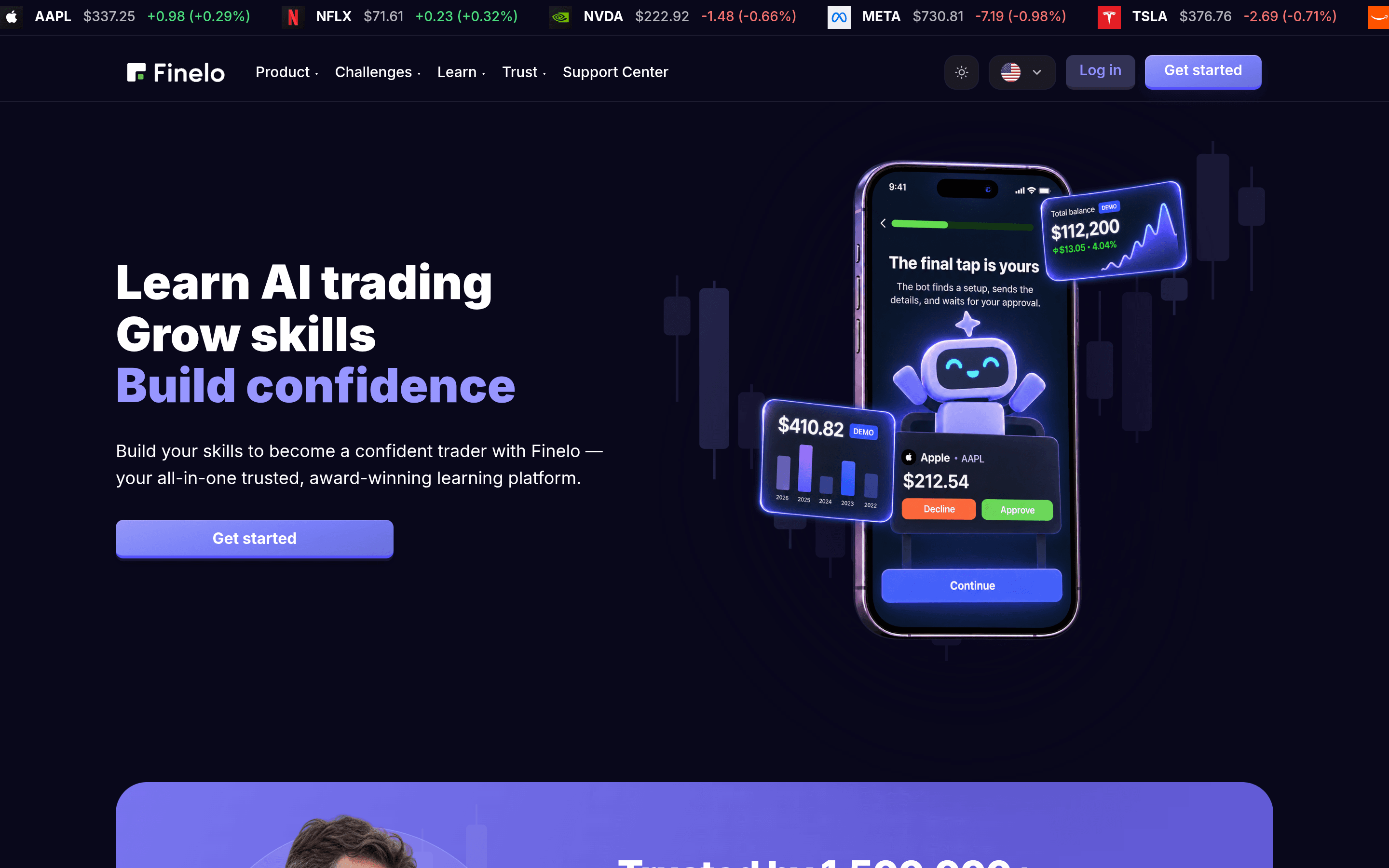
$363.48. That is what a learning app priced at $6.99 a week costs over 52 weeks, or about £271 at $1.34 to the pound. It is more than a year of BabyPips Premium, and nobody who taps "start my free week" on a Tuesday night has done that sum.
One of the recurring complaints about Finelo, the most reviewed of these apps, is about leaving. One user wrote: "I tried 3 times to cancel my subscription".
So, is there a Duolingo for trading? Several apps borrow the streaks and badges, and two of them, Finelo and Capital.com's Investmate, have far more public reviews than we do. But only one of the five lets you fail a lesson properly and then shows the same terms inside a real trade plan. That is Systemly (systemly.ai), and on the six tests below it comes out ahead for a beginner who wants to learn forex rather than collect streaks.
Quick answer: The best app to learn trading for beginners depends on budget and goal. Capital.com's Investmate and IG Academy are the best free options, though both are owned by brokers. Finelo has by far the most reviews and a $1,000 practice simulator, but its plans renew automatically from $6.99 a week. Systemly's academy is the only one of the five that ends a lesson when you answer wrongly too often and sits in the same app as complete forex trade plans, while its free plan covers only part of the course.
Systemly publishes this comparison, and our academy is one of the five apps. We have scored all five on the same six questions, and every competitor fact below is sourced and dated 24 September 2026.
What makes Duolingo work, and what trading apps copy
Think of Duolingo as a gym with a personal trainer who stops the session when your form goes. The streak gets you through the door each day. The hearts, which you lose for wrong answers, are what make you pay attention once you are inside.
Most trading apps have copied the door and skipped the trainer. They have streaks, badges and XP. Research for this article found no competitor that uses a hearts or lives mechanic, where a few wrong answers end your attempt, and none that links graded lessons to a live trade plan with lot sizing.
The common mistake is to pick a learning app by how pleasant the streak feels. The consequence is a daily habit of tapping through three-minute lessons that never ask you to get anything wrong, followed by a first real trade where everything is wrong at once. It is the same as paying for a gym by the week and counting how often you walked in, rather than whether you lifted anything.
The six questions we asked every app
- Can you fail? Does a wrong answer cost you anything, or can you tap until you get it right?
- Are wrong answers reviewed? Can you go back over what you got wrong?
- Is it independent of a broker? Or does the company that teaches you earn when you trade?
- Does it link to real trade plans? Will you see the term you just learned doing a job in an actual entry, stop and size?
- Is the pricing honest? In particular, does it renew weekly by default?
- How deep does it go on forex? Or is it general money skills with a trading coat of paint?
We also recorded how many reviews each app has, because that is where Systemly is weakest, and you should know it.
1. Systemly Academy
Systemly is a UK-built forex and gold trade-planning app that turns live price data into a complete trade plan, with entry, stop, targets, position size and plain-English reasoning, and teaches the terms in a built-in academy of 32 courses.
The Academy is the part built like Duolingo. It holds 123 lessons and 642 graded questions, a little under 12 hours in all, across six subject areas: Foundations, Trading Psychology, Macro & Fundamentals, Technical Analysis, Advanced Tools & Process, and ICT & Smart Money. The ICT strand alone runs to 8 courses and 31 lessons. It has XP, streaks and achievements.
The difference is that you can fail. Every answer is marked, and a few wrong answers end the attempt, so you have to pass a lesson rather than scroll through it. The charts inside lessons are drawn live rather than pasted in as pictures.
Then there is the part no other app on this list attempts. The Academy sits inside the same app as the trade plans. Press scan on an instrument and, in under a minute, you get a plan with an entry, a stop, targets in steps, a position size for your own balance and risk, and the reasoning, including what would make it fail. When that plan says "invalidation" or "lot", the lesson that explains it is in the same place.
The honest catch: Systemly is newer and smaller than Finelo or Investmate, with nothing like their volume of public reviews. Only part of the Academy comes with the free plan, and the paid plans bring alerts, more plans and broker execution. Paid plans start at £9.99 a month (checked 4 October 2026).
2. Finelo
Finelo, which Finelo Limited runs from Cyprus, is a subscription app for learning to trade. Judged by reviews, it is the most popular app on this list by a distance: 4.5 on Trustpilot from 50,521 reviews, and 4.4 on Google Play from 83,300 reviews, with more than a million downloads.
It is easy to see why. You get 28-day challenges, streaks, badges, two AI tools (Chart Analyzer and AI Mentor) and a simulator loaded with $1,000 of virtual money. The simulator in particular is a real strength for a beginner, because it lets you place pretend trades with no money at risk.
The weaknesses are in the pricing and the depth. Finelo costs $6.99 a week, $19.99 per four weeks, or $39.99 per 12 weeks, and every option renews automatically. The common complaints are about cancelling, about refund conditions, and, in one Google Play review, "AI-generated content with errors". Its material stays at beginner level, and nothing in it connects to a live trade plan.
3. Capital.com Investmate
Investmate is a free learning app owned by the CFD broker Capital.com. It has over 30 courses with lessons of about three minutes, quizzes, and a paper-trading simulator. It rates 4.8 on the App Store from 2,100 ratings, and it is the strongest free pick here for anyone who wants short lessons and a place to practise.
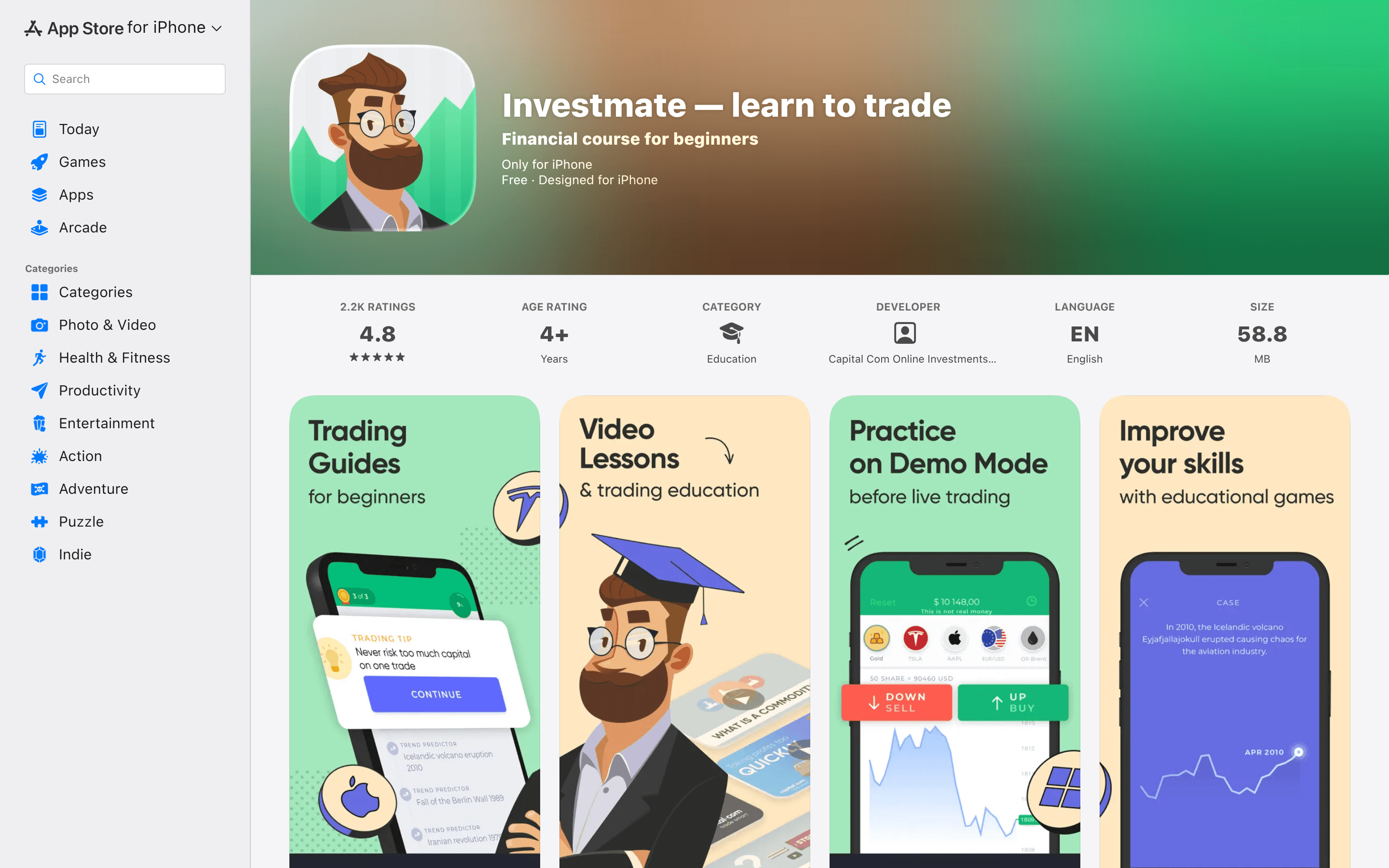
There are two catches. One complaint on its listing is that you cannot review the questions you got wrong, which is where the learning usually is. And because it belongs to a broker, the teacher earns when its students trade. That does not make it a bad app. It means the incentive points towards trading sooner, which we explain in our comparison of broker academies and independent learning.
4. Trading Game (Stock Simulator)
Trading Game has more than 150 lessons with pattern quizzes and rates 4.8 on the App Store from 5,200 ratings. It is priced from $4.99 a week up to $249.99 for lifetime access.
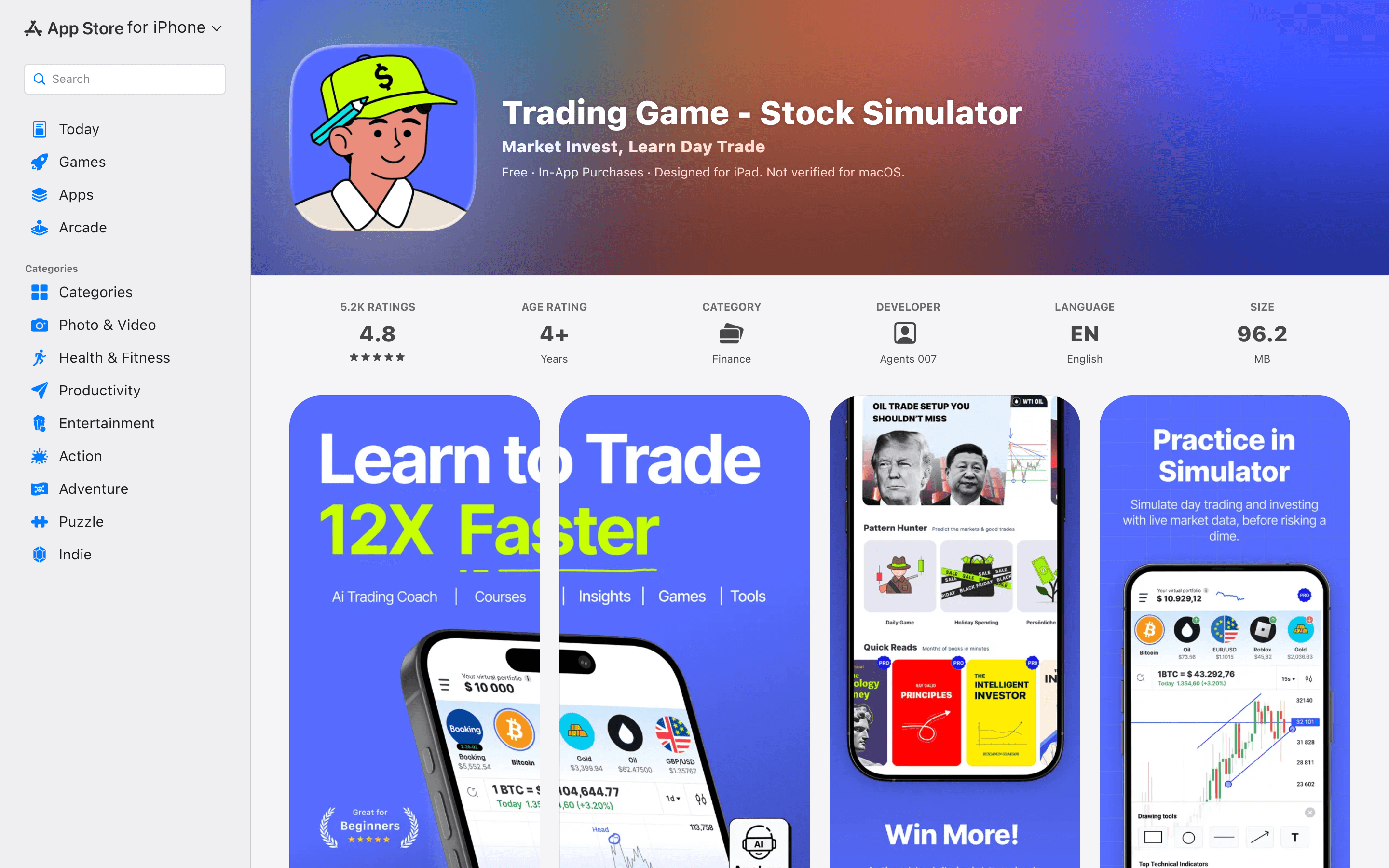
The lifetime option is worth noticing. At $4.99 a week, a year costs $259.48, which is more than the one-off lifetime price. If you are sure you will use it for a year, the lifetime price is the cheaper route. The catch is quality control on the clever features. One App Store complaint says its AI trade analysis "frequently produced incorrect results". Its App Store name includes "Stock Simulator", which suggests a stock focus rather than a forex one.
5. IG Academy
The broker IG runs IG Academy as a free course. It combines videos with interactive exercises and quizzes, keeps track of your progress, and its app rates 4.8. For a beginner who wants a polished, structured and free course from a regulated firm, it is a sound choice.
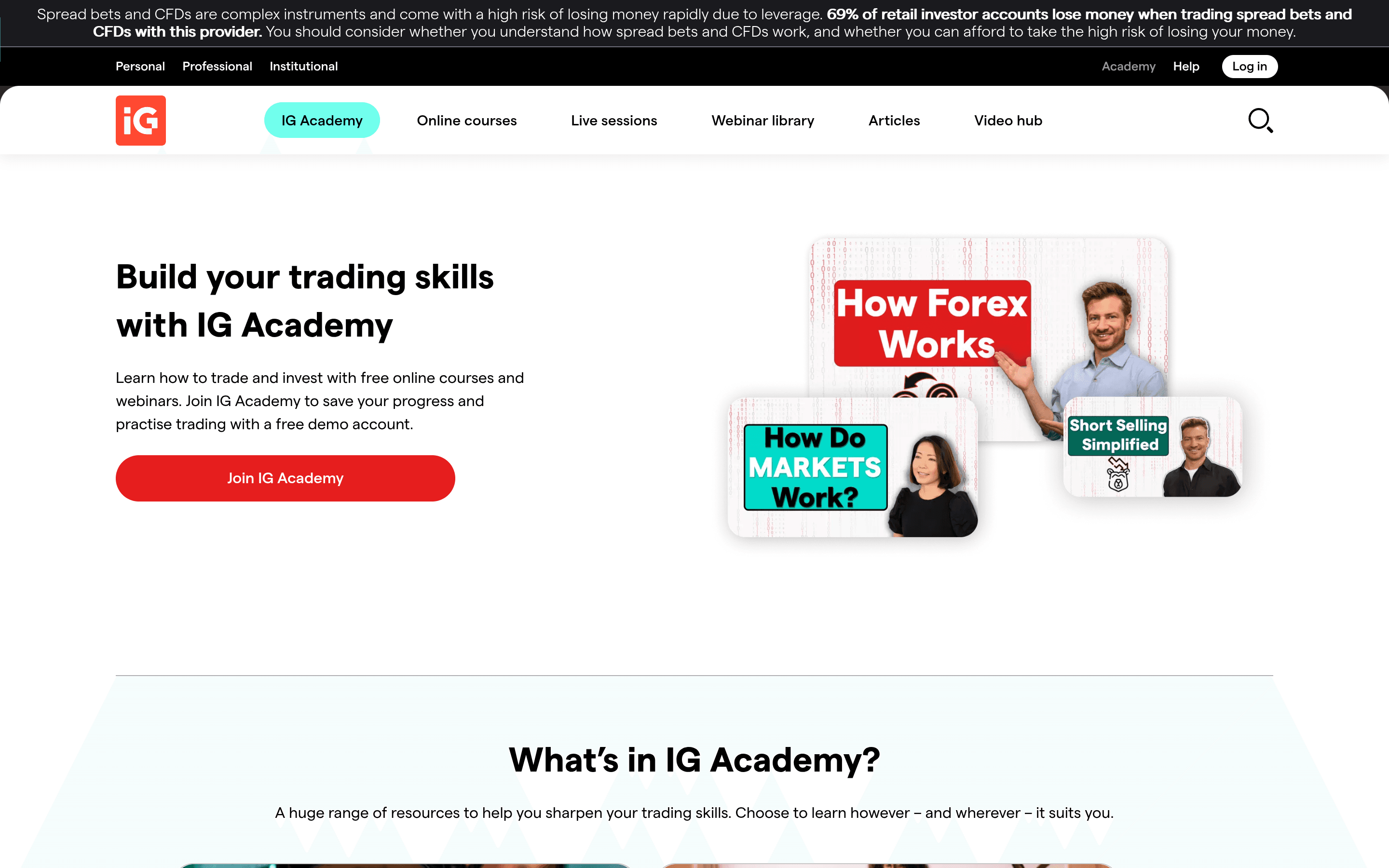
Like Investmate, it is owned by a broker. IG publishes that 69% of its retail CFD accounts lose money, as the FCA's rules on CFDs require it to. Many people learn well from it. Just keep in mind who is teaching and how they earn.
The scorecard: five apps, six questions
- Can you fail?: Systemly Academy: Yes: a few wrong answers end the attempt; Finelo: Challenges and streaks; no lives mechanic found; Investmate: Quizzes; no lives mechanic found; Trading Game: Pattern quizzes; no lives mechanic found; IG Academy: Quizzes; no lives mechanic found
- Wrong answers reviewed?: Systemly Academy: Every answer is marked; no separate review feature is claimed; Finelo: Not stated; Investmate: No, according to one complaint; Trading Game: Not stated; IG Academy: Not stated; progress is saved
- Independent of a broker?: Systemly Academy: Not a broker; connects to your own MT5 account only if you choose; Finelo: Run by Finelo Limited, Cyprus; Investmate: No; owned by Capital.com; Trading Game: Unclear; IG Academy: No; owned by IG
- Linked to real trade plans?: Systemly Academy: Yes, in the same app; Finelo: No; Investmate: No; Trading Game: No; IG Academy: No
- Pricing: Systemly Academy: Free plan with part of the Academy; paid plans; Finelo: $6.99 a week, auto-renewing; Investmate: Free; Trading Game: $4.99 a week to $249.99 lifetime; IG Academy: Free
- Forex depth: Systemly Academy: 32 courses, including an 8-course ICT strand; Finelo: Beginner-only; Investmate: 30+ short courses; Trading Game: 150+ lessons; a stock simulator; IG Academy: Videos, exercises and quizzes
- Practice with fake money: Systemly Academy: Practise its plans on a separate demo account; Finelo: $1,000 virtual simulator; Investmate: Paper-trading simulator; Trading Game: Simulator; IG Academy: Not stated
- Reviews and downloads: Systemly Academy: Newer, with far fewer public reviews; Finelo: 50,521 Trustpilot; 1M+ Google Play downloads; Investmate: 2,100 App Store ratings; Trading Game: 5,200 App Store ratings; IG Academy: App rated 4.8
Look at the bottom two rows before you look at the top. Finelo and Investmate have far more public reviews than Systemly, and three of the four competitors have a built-in simulator. Systemly wins on the rows about failing, independence and the link to real plans, which are the rows this article set out to test.
What those weekly prices really cost
Weekly pricing looks small because it is designed to. Here is each paid option turned into a year, with pounds at an assumed $1.34.
- Finelo weekly: Price as listed: $6.99 a week; Cost over 52 weeks: $363.48; In pounds, roughly: £271
- Finelo 4-weekly: Price as listed: $19.99 per 4 weeks; Cost over 52 weeks: $259.87; In pounds, roughly: £194
- Finelo 12-weekly: Price as listed: $39.99 per 12 weeks; Cost over 52 weeks: $173.29; In pounds, roughly: £129
- Trading Game weekly: Price as listed: $4.99 a week; Cost over 52 weeks: $259.48; In pounds, roughly: £194
- Trading Game lifetime: Price as listed: $249.99 once; Cost over 52 weeks: $249.99; In pounds, roughly: £187
- Investmate: Price as listed: Free; Cost over 52 weeks: $0; In pounds, roughly: £0
- IG Academy: Price as listed: Free; Cost over 52 weeks: $0; In pounds, roughly: £0
The arithmetic: 52 weeks × $6.99 = $363.48. Thirteen four-week periods × $19.99 = $259.87. For the 12-week plan, $39.99 ÷ 12 × 52 = $173.29. On Finelo, choosing the longest period instead of the weekly one saves about $190 over a year.
None of this makes weekly pricing wrong. It makes it something to decide on purpose. Set a calendar reminder for the day before any trial renews.
Green flags: a checklist to screenshot
Before you download any trading app, check it against these.
- A wrong answer costs you something, so you cannot tap your way through.
- You can see what you got wrong and why.
- You know who owns it, and whether they earn when you trade.
- The price is shown per year as well as per week, or you have done the sum yourself.
- Cancelling is as easy as signing up.
- The lessons go past the basics into risk, position sizing and trading psychology.
- At some point you see a real trade, with an entry, a stop and a size, explained in plain English.
- It never promises you will make money.
Which app should you pick?
- If you want the best app to learn trading for free, then Investmate and IG Academy are the free options on this list, and a broker runs each.
- If you want the most popular app with a practice balance, then Finelo has the largest following; its 12-week plan costs far less over a year than the weekly one, and the renewal date is worth noting.
- If you like pattern quizzes and are sure you will use it for a year, then Trading Game's lifetime price beats a year of weekly payments.
- If you want to be made to get answers right, and then to see each term inside a real forex plan with your own position size, then the Systemly Academy is built for that.
Where Finelo or Investmate is the better choice
Finelo and Investmate are the better choice if you want an app with a large, established base of public reviews to judge it by. Systemly cannot offer that yet. Both have a built-in simulator. With Systemly, you practise its plans on a separate demo account. Investmate is free, which matters on a few hundred pounds. Finelo's 28-day challenges suit people who want a fixed programme with a finish line. If those are your priorities, one of them will suit you better than Systemly. For a wider list, see our nine BabyPips alternatives ranked by what they teach.
How we compared
We checked each app's own listing, pricing and review pages on the App Store, Google Play and Trustpilot, plus independent reviews, on 24 September 2026. We scored all five against the same six questions and added a row for reviews and downloads, where Systemly is weakest. We used no Systemly performance or user figures, because we do not publish any. App prices and ratings change often, so check each listing before you subscribe.
FAQ
Is there a Duolingo for trading?
Several apps borrow Duolingo's streaks and badges, including Finelo, Investmate, Trading Game and the Systemly Academy. Research for this comparison found no competitor using Duolingo's hearts or lives mechanic, where a few wrong answers end the attempt. The Systemly Academy does work that way, with XP, streaks and 642 graded questions, and it links its lessons to live forex trade plans.
What is the best app to learn trading for free?
Capital.com's Investmate and IG Academy are the strongest free apps. Investmate offers over 30 short courses, quizzes and a paper-trading simulator, and IG Academy mixes videos, interactive exercises and quizzes. Each belongs to a broker that makes money when its customers trade. Systemly also has a free plan that includes part of its academy, alongside a public feed of community trade scans.
Is Finelo worth it?
Finelo is popular, with 4.5 on Trustpilot from 50,521 reviews, and it offers 28-day challenges and a $1,000 virtual simulator. It costs $6.99 a week, $19.99 per four weeks or $39.99 per 12 weeks, all auto-renewing. Complaints focus on cancelling and refunds, and its content is beginner-only. The 12-week plan costs far less per year than the weekly one.
Which app lets you learn trading with fake money?
Finelo includes a simulator with $1,000 of virtual money, Capital.com's Investmate has a paper-trading simulator, and Trading Game is built around a stock simulator. With the Systemly Academy, the lessons sit beside complete trade plans, which you practise on a separate demo account from your trading platform, using practice money only.
Are trading apps owned by brokers biased?
Broker-owned apps such as Investmate and IG Academy are often good, free and run by regulated firms. The structural issue is that the broker earns when customers trade, so the teacher has an incentive to get you trading sooner. That does not make their lessons wrong. It is worth knowing who owns any app you learn from and how it makes money.
Can a learning app make me a profitable trader?
No app can promise that, and you should be wary of any that does. Most retail CFD accounts lose money. A good learning app can teach you the terms, test that you understand them and show how a complete trade plan manages risk. What happens after that depends on markets, costs and your own decisions.
Try the one that lets you fail
If you want lessons that stop you when you get too many wrong, and then show each term inside a real forex plan, start with the free part of the Systemly Academy. To see a finished plan before you sign up, browse the public feed of community trade scans.
Sources
- Finelo reviews page: https://finelo.com/reviews
- Finelo review by NoBSIMReviews: https://nobsimreviews.com/finelo-review/
- Investmate on the App Store: https://apps.apple.com/us/app/investmate-learn-to-trade/id1229995329
- Trading Game, Stock Simulator, on the App Store: https://apps.apple.com/us/app/trading-game-stock-simulator/id1202332044
- IG Academy: https://www.ig.com/uk/learn-to-trade/ig-academy
- FCA, permanent restrictions on CFDs: https://www.fca.org.uk/news/press-releases/fca-confirms-permanent-restrictions-sale-cfds-and-cfd-options-retail-consumers
- BabyPips Premium lock-in page: https://premium.babypips.com/lock-in
- Systemly: https://www.systemly.ai
- Systemly Academy: https://www.systemly.ai/academy
- Systemly community scans: https://app.systemly.ai/scans
Trading forex and CFDs carries a high risk of losing money, and most retail accounts do. Systemly is an educational and trade-planning tool. It does not provide financial advice or personal recommendations, and it is not authorised by the FCA to do so. Past outcomes do not predict future results.