
The best way to learn forex trading in the UK in 2026: 6 routes ranked by what they get you to do
 Systemly Team
"There's so much information out there that it's overwhelming, and I'm not sure what to focus on first"
That line was posted on r/Trading, and it could have been written by nearly anyone in their first year. You have a BabyPips tab open, a YouTube video paused at the eleven-minute mark, a Telegram group pinging in the background and a ChatGPT answer you are not sure you trust. Every source is confident. None of them agrees on what comes first.
The problem is rarely a shortage of information. It is the absence of an order.
The best way to learn forex trading is to learn the terms in a graded order and use them straight away on complete trade plans, with practice money or very small risk, so your mistakes stay cheap. That is why learn-by-doing apps rank first below, followed by free courses, broker academies, AI tutors, paid courses, and YouTube and TikTok.
Quick answer: The best way to learn forex trading in the UK in 2026 is to combine a graded course with real trade plans and a demo account, so every term you learn is used in a decision straight away. Learn-by-doing apps such as the Systemly Academy do this in one place. Free courses such as BabyPips and broker academies such as IG Academy are excellent, low-cost foundations, AI tutors are useful explainers, and paid courses are rarely necessary for a beginner. YouTube and TikTok can supplement a course but make a poor spine, because a large share of finance videos have been found to be misleading.
Systemly publishes this comparison, and our Academy sits inside route 1. We have ranked on a stated criterion so you can check our reasoning, and every competitor fact below is sourced and dated 24 September 2026.
How we ranked the six routes
We ranked each route on one question: does it get you from knowing a term to using it in a real decision, safely? A route that teaches you what a stop-loss is scores lower than one that asks you where the stop goes and marks your answer. We also looked at four things:
- Order: is there a sequence, or do you assemble it yourself?
- Grading: does anything tell you when you are wrong?
- Incentives: how does the teacher get paid, and does that push you towards trading sooner?
- Cost: in money and in time.
1. Learn-by-doing apps
- Best for: beginners who want lessons and real trade decisions in the same place.
- Typical cost: free plans exist; paid tiers vary.
- The catch: less total material than the biggest video courses, and apps differ hugely in depth.
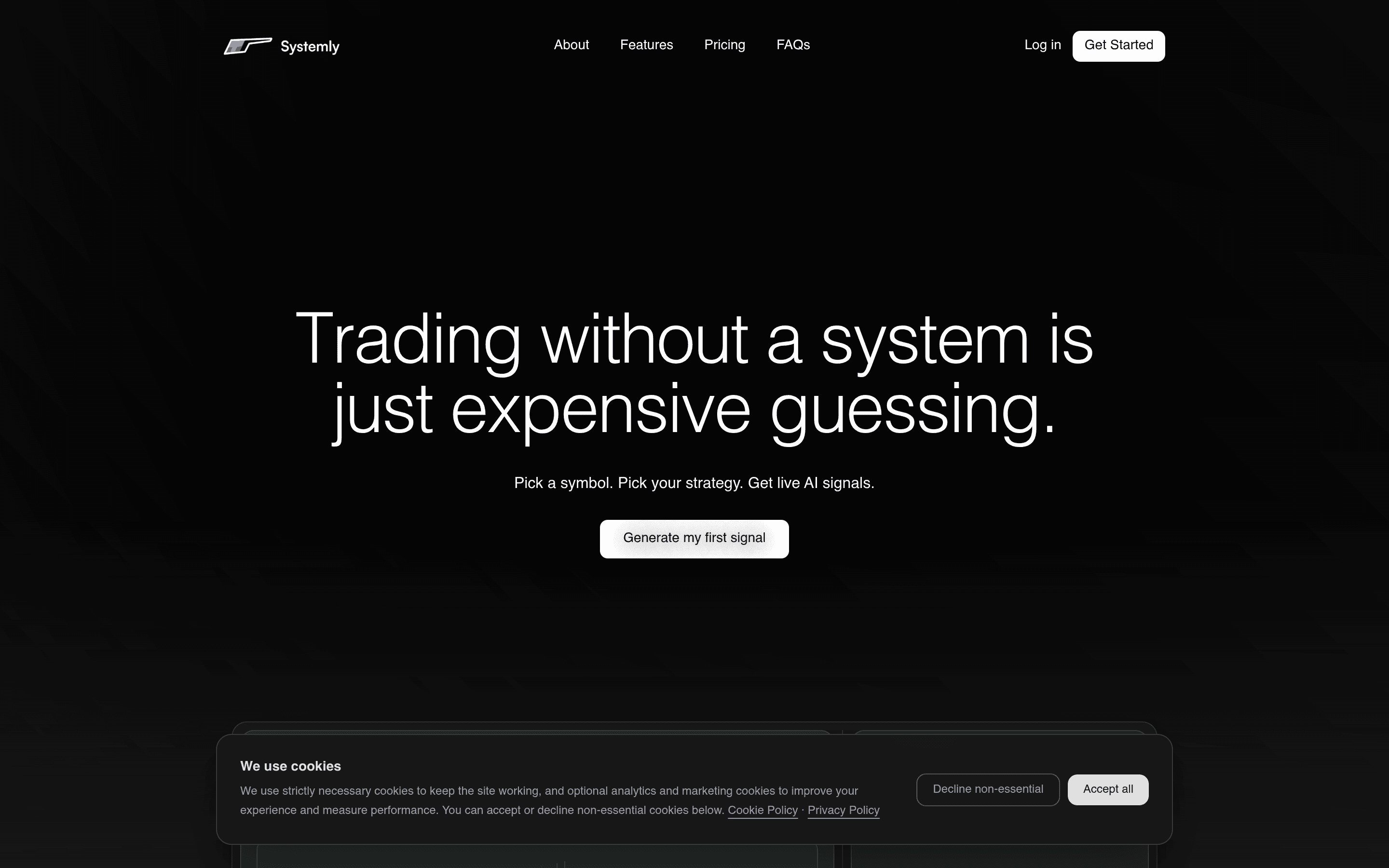
Systemly (systemly.ai) is a UK-built forex and gold trade-planning app that turns live price data into a complete trade plan, with entry, stop, targets, position size and plain-English reasoning, and teaches the terms in a built-in academy of 32 courses.
The Academy has 123 lessons and 642 graded questions across six subject areas, from Foundations and Trading Psychology to ICT & Smart Money. It is not a video library. Questions are marked as you go, and a few wrong answers end the attempt, which means a lesson is passed rather than scrolled past. When a term such as stop, lot, invalidation or liquidity appears in a trade plan, the lesson that explains it sits in the same app. The free plan includes part of the Academy, and paid plans add alerts, more plans and broker execution (from £9.99 a month, checked 4 October 2026).
Finelo is the best-known gamified alternative, with 28-day challenges, a simulator with $1,000 of virtual money, and a Trustpilot score of 4.5 from 50,521 reviews. It is far bigger than Systemly by reviews and downloads. It costs $6.99 a week, $19.99 per four weeks or $39.99 per twelve weeks, all auto-renewing, and its content is aimed at beginners only and is not linked to live trade plans.
Go deeper: why finishing a course does not mean you can place a trade, which includes a 30-day learn-by-doing plan, and the Duolingo-style trading apps compared.
2. Free courses
- Best for: readers who like a clear, friendly text course and a big community.
- Typical cost: free for the basics.
- The catch: theory without a live trade attached, and some advanced material has moved behind paywalls.
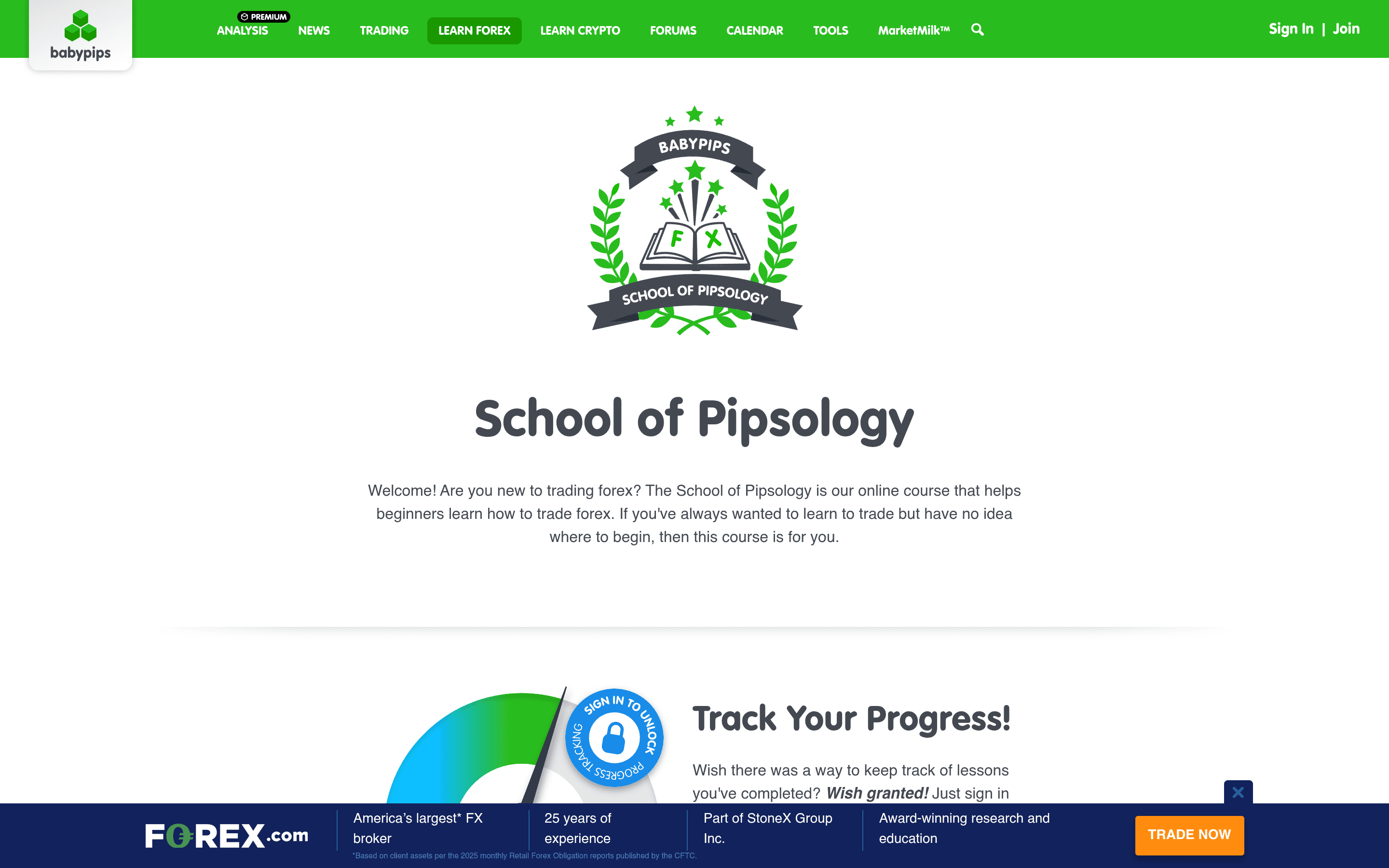
BabyPips' School of Pipsology is the most loved free course in forex. It is a text course with illustrations, grade levels from "Preschool" to "Doctorate", and quizzes at the end of sections. It has a long-standing forum, a friendly tone and a clear sequence. On Trustpilot it scores 4.8 from 443 reviews.
In 2026 BabyPips rewrote the School and moved part of it behind the Premium paywall, which rose from $9.99 to $29 a month from 8 April 2026. BabyPips says "more than half of all School lessons are still free", and a promo page advertises "169 FREE LESSONS". One r/Forex user called the old version "the single most useful course available online that isn't paywalled to death".
A fair criticism of any text course is the one a BabyPips forum member made: "It aims not to teach you how to trade, but rather to provide some basic information about trading." That is the gap route 1 tries to close.
Go deeper: BabyPips vs Systemly after the price rise and nine BabyPips alternatives ranked.
3. Broker academies
- Best for: beginners who want polished, free lessons from a regulated firm.
- Typical cost: free.
- The catch: the teacher earns when you trade.
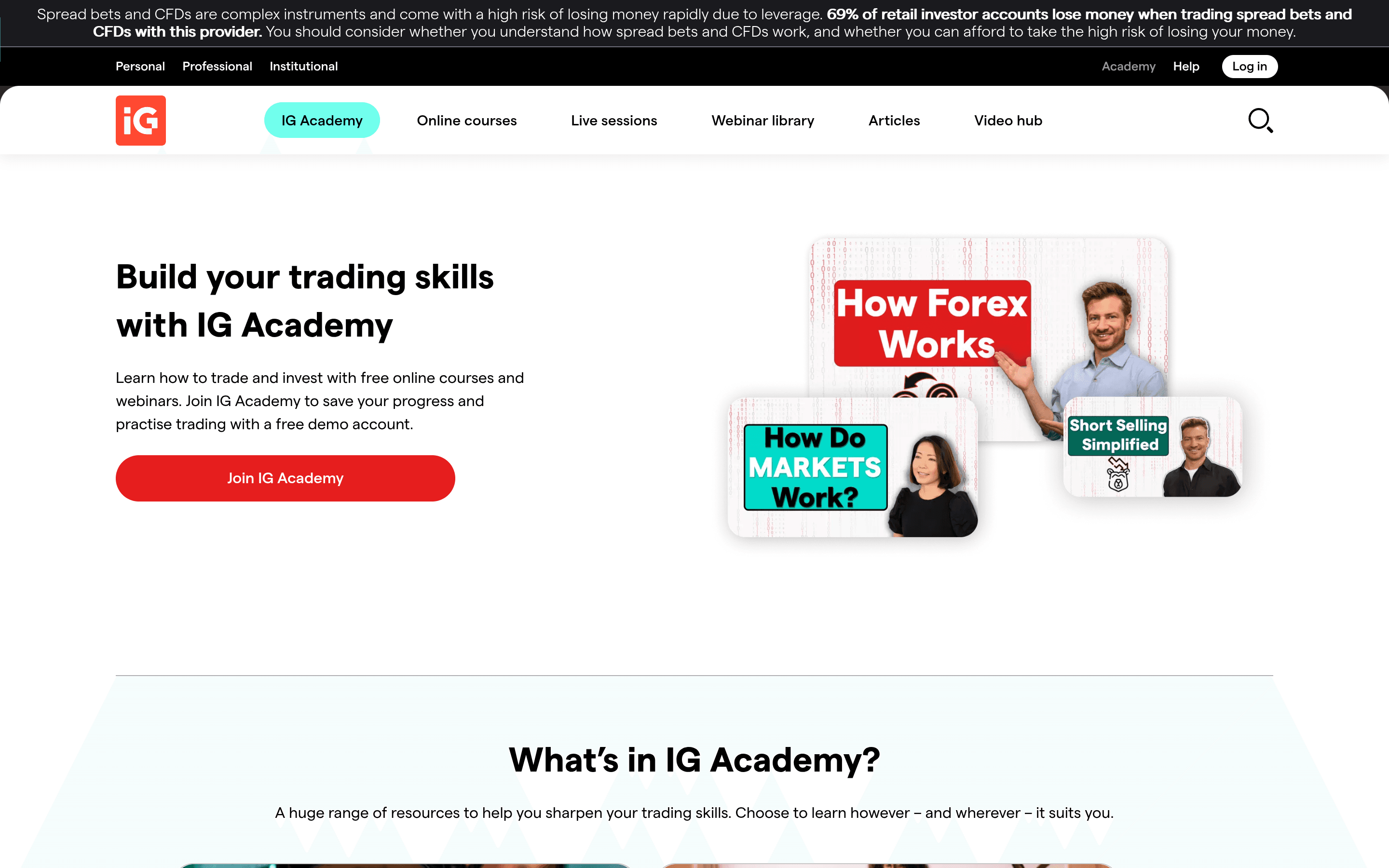
IG Academy offers videos, interactive exercises, quizzes and saved progress, and its app is rated 4.8. eToro Academy adds a $100,000 virtual portfolio. Capital.com's Investmate app has more than 30 courses in three-minute lessons with quizzes and a paper-trading simulator. These are good products, run by regulated firms, and they cost nothing.
The structural point is simple: a broker earns when you trade, so the natural end of every lesson is a live account. Each firm must also publish the share of its retail CFD accounts that lose money. For IG it is 69%, and for Capital.com it is 79.75%.
Go deeper: IG Academy, eToro Academy and the independent option.
4. AI tutors
- Best for: getting a confusing term explained five different ways at midnight.
- Typical cost: free, or about $20 a month for ChatGPT's paid tier.
- The catch: no sequence, no independent grading, and the risk of made-up prices.
AI has become a first stop. In FCA research covering 666 people aged 18 to 40, 80% said they had used AI for investment decisions, and 44% wrongly believed AI financial information is FCA-regulated. A DayTrading.com test of six AI models in August 2025 found made-up prices, arithmetic mistakes and pattern errors in about 60% of chart prompts. That test is not peer-reviewed and comes from a commercial site, so treat it as a warning rather than a verdict.
Go deeper: can ChatGPT teach you to trade?
5. Paid courses
- Best for: learners with a specific goal, such as US stock trading or an academic grounding.
- Typical cost: from $10 on Udemy to $4,999 for Rayner Teo's top tier.
- The catch: price and hours of video are poor guides to whether you will learn to make decisions.
Paid courses range from cheap Udemy videos (most sell at $10 to $20) to multi-thousand-dollar programmes. Two of the best known, Warrior Trading and Bear Bull Traders, teach US stocks rather than forex. In 2022 Warrior Trading settled with the US Federal Trade Commission for $3 million over "misleading and unrealistic claims" of earnings.
One r/Trading user offered the sharpest test: "most people selling 'my strategy' make their money from the course, not the trading." Judge any paid course by whether it makes you practise decisions and grades you.
Go deeper: what eight popular forex courses cost per lesson.
6. YouTube and TikTok
- Best for: supplementing a course with a particular teacher whose style clicks.
- Typical cost: free in money, expensive in time.
- The catch: no order, no grading, and a high share of misleading content.
Some YouTube teachers are excellent, and the free ICT 2022 Mentorship shaped the vocabulary a generation of traders now uses. The problem is the pool. A Legalaes study of 1,764 finance videos found YouTube had the highest share of misleading videos of four platforms, at 41.8%, with disclaimers on 11.7%. A study of 13,216 UK TikTok finfluencer videos found disclaimers on fewer than 2% per month, with forex and crypto trading a main theme.
The hidden cost is strategy hopping. As one trader put it after blowing more than 80 prop firm accounts: "there were three different strategies arguing in my head."
Go deeper: can you learn forex from YouTube and TikTok? and the ICT mentorship vs a structured smart money course.
The six routes compared
- 1. Learn-by-doing apps (e.g. Systemly): Typical cost: Free plan; paid tiers vary; Set structure: Yes; Grades you: Yes; Uses terms in a real trade decision: Yes; How the teacher is paid: Paid plans or subscriptions
- 2. Free courses (e.g. BabyPips): Typical cost: Free basics; Premium $29 a month; Set structure: Yes; Grades you: Quizzes; Uses terms in a real trade decision: No; How the teacher is paid: Premium, ads, partners
- 3. Broker academies (e.g. IG Academy): Typical cost: Free; Set structure: Yes; Grades you: Quizzes; Uses terms in a real trade decision: Some, through practice money; How the teacher is paid: Your trading
- 4. AI tutors (e.g. ChatGPT): Typical cost: Free, or about $20 a month; Set structure: No; Grades you: Only if you ask; Uses terms in a real trade decision: No; How the teacher is paid: Subscriptions
- 5. Paid courses: Typical cost: $10 to $4,999; Set structure: Usually; Grades you: Varies; Uses terms in a real trade decision: Varies; How the teacher is paid: Course sales
- 6. YouTube and TikTok: Typical cost: Free; Set structure: No; Grades you: No; Uses terms in a real trade decision: No; How the teacher is paid: Ads, sponsors, referrals
Route 1 does not win every column. Free courses and broker academies are cheaper, and a large text course or video series offers more material than any app. The case for learn-by-doing rests on the fourth column.
Is forex trading legal in the UK?
Yes. Forex trading is legal in the UK, and firms that sell leveraged products such as CFDs to retail clients are regulated by the Financial Conduct Authority. Since 1 August 2019, the FCA's permanent CFD rules have applied:
- leverage is capped at between 30:1 and 2:1, depending on the market
- positions are closed out when margin falls to 50%
- retail clients have negative balance protection
- firms must publish the percentage of their retail accounts that lose money
What is not legal is promoting regulated products without approval. Under the FCA's finalised guidance on social media promotions (FG24/1), unauthorised influencers who promote regulated products "may be committing a criminal offence".
That is no longer theoretical. On 20 February 2026, seven influencers were sentenced at Southwark Crown Court over unauthorised promotions of an FX trading scheme. Lauren Goodger was paid £2,275 for four posts and was fined £3,750 plus £5,778.18 in costs. The posts promised "free signals", "consistent profits" and "no experience needed". The FCA said: "These influencers betrayed the trust of those who followed them."
Separately, three other finfluencers were charged over promoting forex CFDs and made their first court appearance on 10 September 2025. They pleaded not guilty and trials are listed for 2027.
The practical lesson: if the person teaching you also sells signals or a broker link, check whether they are authorised before you act on anything they say.
A word on tax
Tax is outside the scope of this guide, and we cannot advise on it. In the UK, spread betting and CFD trading can be treated differently for tax purposes, and the treatment depends on your own circumstances and can change. Check HMRC's guidance or speak to a qualified tax adviser before you trade, not after.
How to learn forex trading for free
A sensible free stack looks like this:
- A free, sequenced course for the basics, such as BabyPips' free lessons, a broker academy or the free plan of the Systemly Academy.
- A demo account set to the balance you would really trade with, not a fantasy balance.
- Complete trade plans to study, such as the public feed of community scans, so you can see how a stop, a target and a size fit together.
- A free risk check before every practice trade, such as the Risk Doctor tool, which checks a trade's risk and position size before you place it.
The first rule, worked in numbers
One r/Trading user wrote: "Most accounts don't die from one bad trade. They die from a series of oversized trades and no real process." Whatever route you choose, the first thing to learn is sizing, so here it is on gold.
Picture a £500 account (about $670, if we assume $1.34 to the pound), a 1% risk limit of $6.70, and a gold stop $4.00 from entry. Depending on the platform, that stop may be labelled 400 points or 40 pips.
- Contract size (an assumption; brokers differ): Sum: 1 standard lot = 100 oz; Result: Check your broker's specification
- Loss if one full lot hits the stop: Sum: $4.00 × 100; Result: $400
- Exact size for a $6.70 risk: Sum: $6.70 ÷ $400; Result: 0.01675 lots
- Nearest size below that most brokers accept: Sum: Round down; Result: 0.01 lots
- What the stop really costs at 0.01 lots: Sum: 0.01 × $400; Result: $4.00, about 0.6% of the account
- What it would cost at 0.02 lots: Sum: 0.02 × $400; Result: $8.00, about 1.2% of the account
The rounded-down trade stays inside the 1% limit. The rounded-up one breaks it, and doubles the loss if the stop is hit.
A route that never makes you do this sum has not taught you to trade.
Where the other routes are the better choice
Learn-by-doing ranks first on our criterion, but other routes win for particular people.
- Free courses are the better choice if you want a large free text library and a long-standing community forum, which BabyPips offers.
- Broker academies are the better choice if you want polished free lessons and built-in virtual money from a regulated firm.
- AI tutors are the better choice for instant, patient explanations of a single confusing term.
- Paid courses are the better choice if you want to trade US stocks, which is not what the Systemly Academy is built around, or want academic depth, such as Yale's "Financial Markets" course on Coursera.
- YouTube is the better choice once you have the basics and want to study one teacher's method in depth.
Which route fits you: a decision tree
- If you have never placed a trade and are not sure what a lot is, then start with a free, graded course and a demo account before anything else.
- If you have finished a theory course but freeze when it is time to place a trade, then move to a learn-by-doing route where terms appear in real plans.
- If you learn best by reading and want a community, then BabyPips' free lessons are the strongest free start.
- If you want free lessons with practice money built in and are comfortable learning from a broker, then a broker academy fits, but set your demo balance to match your real one.
- If you are about to pay for a course, then check first whether it teaches your market, grades you and costs less than your trading account.
- If someone on social media offers free signals or promises consistent profits, then check whether they are authorised by the FCA before you do anything else.
How we compared
We ranked six routes to learning forex: learn-by-doing apps, free courses, broker academies, AI tutors, paid courses, and YouTube and TikTok. We judged each on whether it moves you from knowing a term to using it in a real decision, and on order, grading, incentives and cost. Facts come from providers' own pages, the FCA, app stores, review platforms, published studies and Reddit threads, all listed below and checked on 24 September 2026. Prices, courses and rules change, so check each source directly before you decide.
FAQ
What is the best way to learn forex trading?
The best way to learn forex trading is to follow a graded, structured course and use each term straight away in complete trade plans, practising on a demo account or with very small risk. Theory alone leaves a gap between knowing and doing. Learn-by-doing apps close that gap; free courses and broker academies are strong, low-cost foundations.
How can I learn forex trading for free?
You can learn forex trading for free with BabyPips' free lessons, a broker academy such as IG Academy, and the free plan of the Systemly Academy. Add a demo account set to your real balance, study complete trade plans, and check every practice trade's risk and position size. Free routes cost time, so choose one with a clear order.
Is forex trading legal in the UK?
Yes. Forex trading is legal in the UK, and firms that offer CFDs to retail clients are regulated by the FCA. Since 2019, leverage has been capped at between 30:1 and 2:1, with negative balance protection. Promoting regulated trading products without authorisation can be a criminal offence, and seven influencers were sentenced for it in February 2026.
Is forex trading good for beginners in the UK?
Forex trading carries a high risk for beginners, and most retail CFD accounts lose money; the FCA said in September 2025 that 80% of customers lose money when investing in CFDs. If you do learn, start with a graded course and a demo account, keep risk per trade small, and never trade money you cannot afford to lose.
Do you pay tax on forex trading in the UK?
Tax on forex trading in the UK depends on how you trade and on your personal circumstances. Spread betting and CFD trading can be treated differently, and the rules can change. This is not something to guess or take from social media. Check HMRC's guidance or speak to a qualified tax adviser before you start trading.
Can you learn forex from YouTube?
You can learn parts of forex from YouTube, and some teachers are excellent. The risks are no fixed order, no grading, and a high share of misleading content: one 2026 study of 1,764 finance videos found 41.8% of YouTube's were misleading. YouTube works best as a supplement to a structured course rather than as the course itself.
Start with a plan you can read
If you want the terms in a graded order and a real trade plan to use them on, start with the free plan of the Systemly Academy, then see how the words fit together on Systemly's trade-planning app.
Sources
- Reddit r/Trading, "so much information out there"
- Finelo reviews and pricing
- BabyPips Premium lock-in page
- BabyPips on Trustpilot
- Reddit r/Forex, "paywalled to death"
- BabyPips forum on the School of Pipsology
- IG Academy
- Capital.com Investmate on the App Store
- The Currency Analytics on the FCA AI study
- DayTrading.com AI model test (August 2025)
- Udemy forex topic page
- Rayner Teo, Ultimate Systems Trader
- FTC v. Warrior Trading
- Reddit r/Trading, "my strategy"
- PPC Land on the Legalaes study
- UK TikTok finfluencer study
- Reddit r/myfundedfutures, "three different strategies"
- FCA permanent CFD restrictions
- FCA FG24/1 finalised guidance
- FCA on the influencer sentencing
- Express & Star on the influencer case
- FCA on three finfluencers charged
- Reddit r/Trading, "oversized trades"
- Systemly
- Systemly Academy
- Systemly Risk Doctor
- Systemly community scans
Trading forex and CFDs carries a high risk of losing money, and most retail accounts do. Systemly is an educational and trade-planning tool. It does not provide financial advice or personal recommendations, and it is not authorised by the FCA to do so. Past outcomes do not predict future results.