
Forex gurus on TikTok: who profits when you lose, and what to use instead
 Systemly Team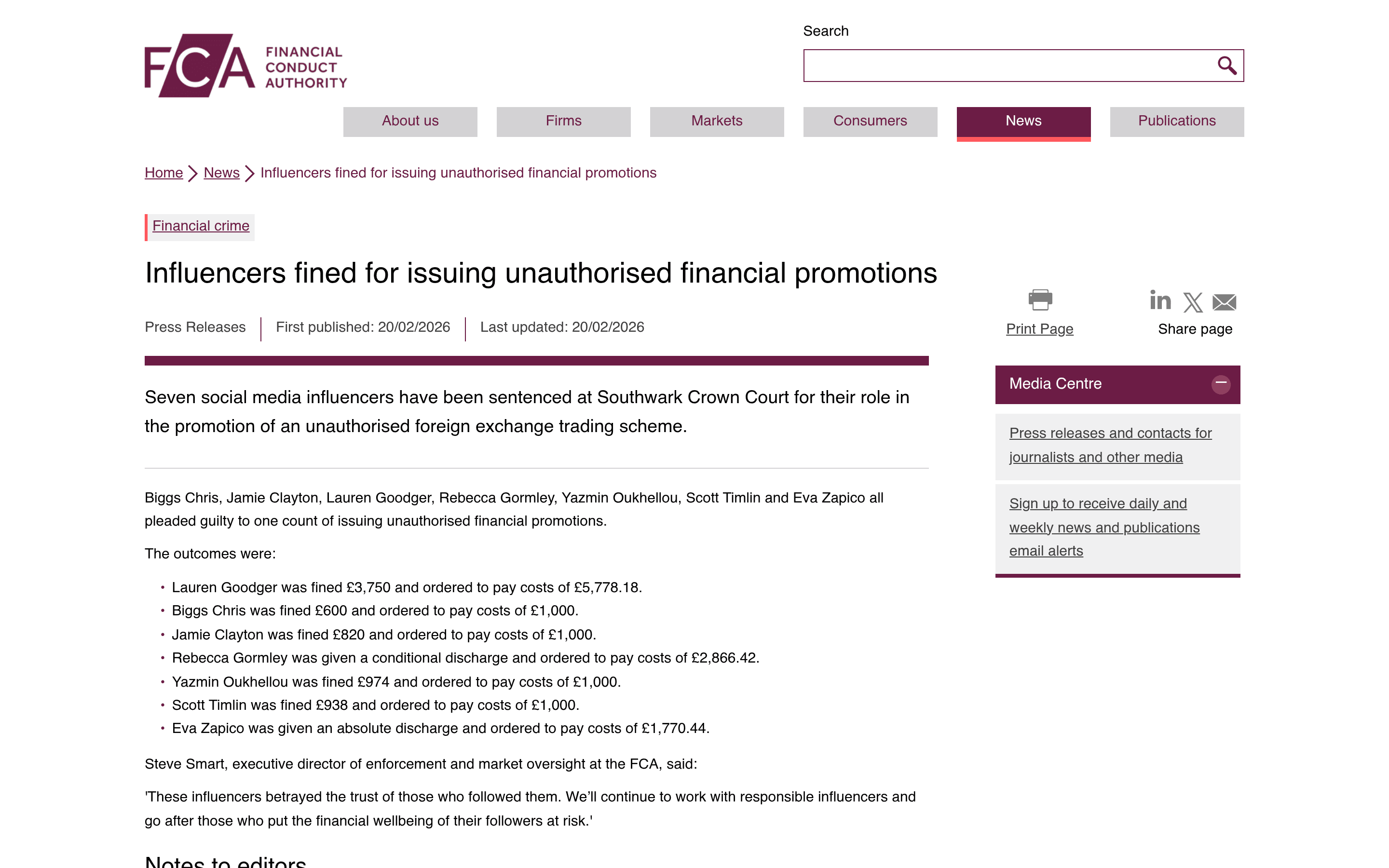
Lauren Goodger was paid £2,275 for four Instagram posts promoting a foreign exchange trading scheme. On 20 February 2026, at Southwark Crown Court, she was fined £3,750 and ordered to pay £5,778.18 in costs. Scott Timlin had been paid £900 for three videos. He was fined £938.
The posts, according to the Express & Star's court report, promised "free signals", "consistent profits" and "no experience needed". Seven influencers were sentenced that day.
The short answer to the question in the headline is this. Many forex gurus on TikTok and Instagram are paid when you click, subscribe or trade, and not when you win. If you are learning, choose sources that tell you plainly how they are paid, and that show you the working behind every trade.
Quick answer: Many forex gurus earn mainly from free-to-VIP signal funnels, courses and broker referral payments, so their income grows when followers trade more, win or lose. Some creators still teach well for free and suit people who want motivation and ideas. Systemly suits a beginner who wants every trade shown in full, with the stop, the reason, the size for their balance and a record of what happened, from a tool that is not a broker and does not take the other side of your trades. Neither is financial advice, and neither removes the risk of loss.
Systemly publishes this comparison. We have tried to be fair, and every competitor fact below is sourced and dated 24 September 2026.
What happened at Southwark Crown Court?
The case began with charges in May 2024. On 20 February 2026 seven influencers were sentenced over unauthorised promotions of an FX trading scheme, as announced by the FCA. They had pleaded guilty to issuing unauthorised financial promotions.
- Lauren Goodger: Paid for the posts: £2,275 for four posts; Sentence: £3,750 fine plus £5,778.18 costs
- Scott Timlin: Paid for the posts: £900 for three videos; Sentence: £938 fine
- Yazmin Oukhellou: Paid for the posts: Not stated in our sources; Sentence: £974 fine
- Jamie Clayton: Paid for the posts: Not stated in our sources; Sentence: £820 fine
- Biggs Chris: Paid for the posts: Not stated in our sources; Sentence: £600 fine
- Rebecca Gormley: Paid for the posts: Not stated in our sources; Sentence: Conditional discharge
- Eva Zapico: Paid for the posts: Not stated in our sources; Sentence: Absolute discharge
The FCA's own summary was blunt: "These influencers betrayed the trust of those who followed them."
The legal line is not new. In its March 2024 guidance on financial promotions on social media, the FCA said that unauthorised influencers who promote regulated products without approval "may be committing a criminal offence".
The case is also not the only one. On 10 September 2025 three further people, whom we are not naming here, made a first court appearance charged with promoting forex CFDs. They have pleaded not guilty, their trials are listed for 2027, and nothing here suggests they are guilty of anything. In April 2026 the FCA led a global action with 17 regulators that found 1,267 illegal ads reaching at least 2.34 million UK accounts and sent 120 takedown requests.
The numbers show why regulators care. An FCA annual report found that one unregulated firm promoted by finfluencers cost 90,000 UK retail investors £75m over four years.
How does a forex guru make money?
The sentences above are about unauthorised promotion. Most forex content on TikTok never reaches a courtroom. It is still worth understanding how it is paid for, because the payment shapes the advice. The funnel has five stages.
Stage one: the post
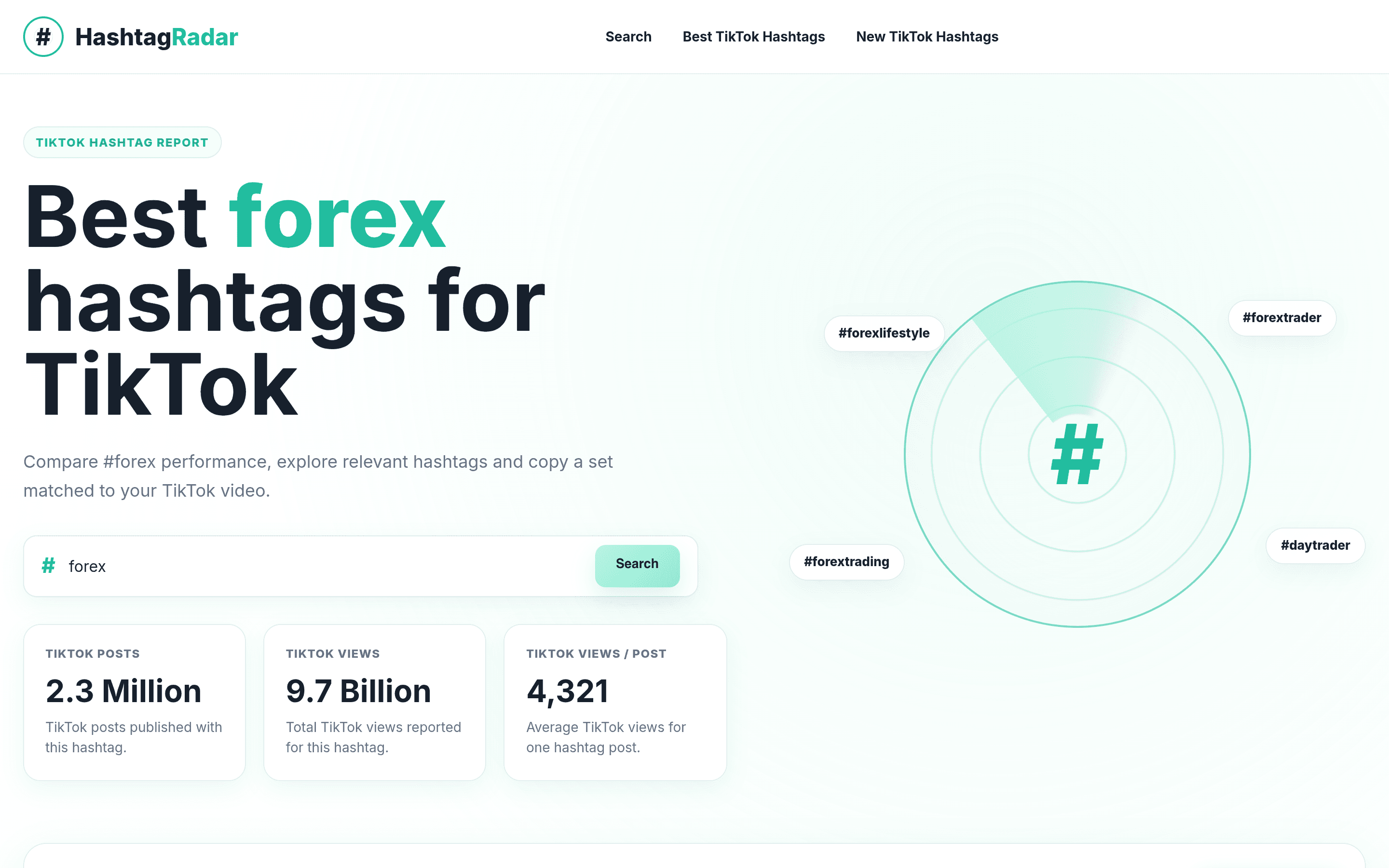
The formats are familiar to anyone who has scrolled past them. Finveroo's round-up of fake trading gurus lists the lifestyle flex, the multi-monitor "live trade", hooks like "quit your 9 to 5" and "turn $100 into $10,000", and a Telegram link in the bio. The audience is large. HashtagRadar counts 2.3 million posts and 9.7 billion views under #forex, and 205,100 posts and 658.3 million views under #forexsignals.
Stage two: the free Telegram channel
The link in the bio usually leads to a free channel. It posts signals and, often, screenshots of results. As one r/FakeGuru user described a group they had followed: "Everyone there posted their wins after the fact… Never before it happened. Always after." (r/FakeGuru).
Stage three: the VIP tier, or the broker
According to JP Trading Capital's guide to free Telegram signals, the VIP tier typically costs $50 to $300 a month, or it is free if you trade through a partner broker. One r/Forexstrategy user described exactly that choice: "to join Mo's premium you don't need to pay anything you just need to use the broker he says" (r/Forexstrategy).
Stage four: the rebate
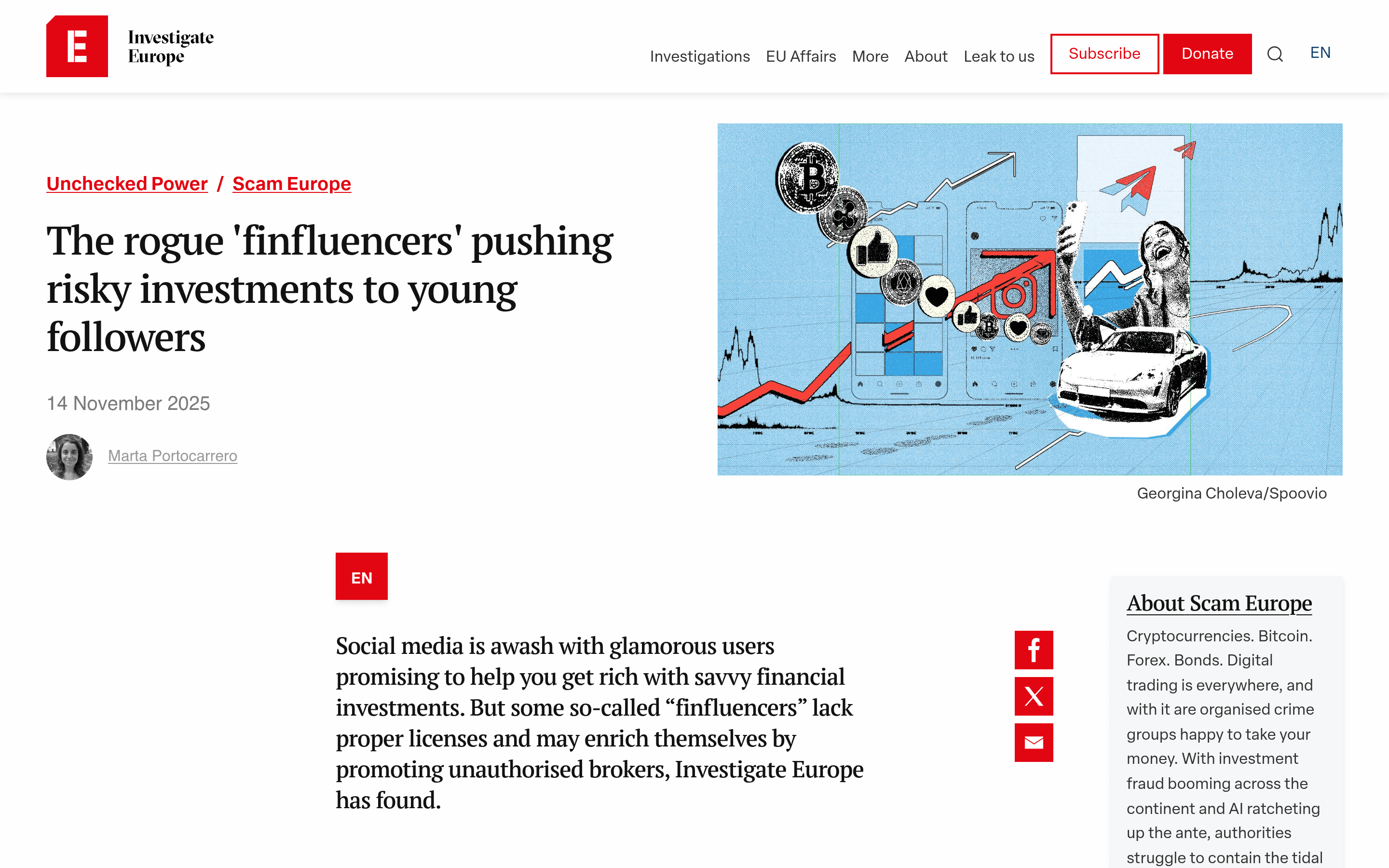
This is the stage most followers never see. Introducing-broker rebates are paid per standard lot the referred trader trades, so they "reward volume persistence". Some programmes pay a flat sum instead. Vantage's affiliate programme pays up to $600 per qualified client. Investigate Europe has documented finfluencers sending followers to brokers through affiliate links.
One r/trading212 user summed up what that means for the follower: "They earn commissions on your trades—win or lose. The more you trade (even unprofitably), the more they make." (r/trading212). Another, on r/FakeGuru, wrote: "I followed brokers who dressed up referral codes as advice."
The regulator noticed this years ago. In a December 2022 "Dear CEO" letter to CFD brokers, the FCA wrote, as reported by FX News Group: "Some affiliates market themselves as FX 'educators' and 'signals providers.'"
Stage five: the course
The last product is often the strategy itself, sold as a course. One r/Trading user wrote a line worth keeping: "most people selling 'my strategy' make their money from the course, not the trading." (r/Trading).
Put the five stages together and a pattern appears. In none of the five stages does the payment depend on a follower making money. They are paid for attention, for subscriptions, for account sign-ups and for volume.
What did Daniel Savage admit?
In December 2025, as reported in a trade-media summary by FastBull, the trading influencer Daniel Savage admitted in an apology video that his profit screenshots were fake. He said the cars came through his car wash job, and that his income came from courses, signals and broker kickbacks rather than from trading.
It is one reported case and should be read as that. It is also a clear description of the funnel above, from the inside. One r/Adulting user had made a similar point: "Almost all of these 18 year olds with lambos rented them for an IG post or a Tiktok shoot." (r/Adulting).
Follow the money: who earns what from your trading
This is the table the rest of the article has been building to. It sets four common sources of trades and teaching side by side, and asks one question of each: how does it get paid?
- Main income: Forex influencer: Courses, VIP access, affiliate and IB payments; Telegram signal group: VIP subscriptions or broker rebates; CFD broker: Spreads and commissions on your trades; Systemly: Paid plans (there is also a free plan)
- Sets your spread or commission?: Forex influencer: No, but IB rebates are paid per lot; Telegram signal group: No, but IB rebates are paid per lot; CFD broker: Yes; Systemly: No; it is not a broker
- Earns when you lose?: Forex influencer: Rebates are paid win or lose; Telegram signal group: Rebates are paid win or lose; CFD broker: Yes, the broker earns when you trade; Systemly: Not a broker; does not take the other side of your trades
- FCA-authorised?: Forex influencer: Usually not; Telegram signal group: Usually not; CFD broker: FCA-regulated brokers are; Systemly: No, and it does not give advice
- What you can check: Forex influencer: Posts and screenshots; Telegram signal group: Posted results; CFD broker: Its published share of losing retail accounts; Systemly: Each plan's stop and size before you trade, and its tracked outcome, losses included
- Cost to start: Forex influencer: Free content; Telegram signal group: Free channel, VIP $50 to $300 a month; CFD broker: Free account and academy; Systemly: There is a free plan
Two rows need a word of explanation.
The FCA row is where a regulated broker beats both the influencer and Systemly. A regulated broker is authorised, has to follow FCA rules and must publish its own percentage of losing retail accounts under the FCA's permanent CFD restrictions from 2019. Systemly is a planning and education tool. It is not authorised by the FCA and does not give personal recommendations.
The income rows are where the business models differ most. Systemly has a free plan and paid plans. It is not a broker, so it does not hold your money, set your spread or take the other side of your trades. The plan it hands you shows the stop and the size before you decide anything.
Gurus as teachers: what TikTok teaches you, and in what order
Forex influencers are not only signal sellers. For many beginners they are the first teachers. That side deserves its own look.
The research is not encouraging. A study of 13,216 UK TikTok finfluencer videos found that disclaimers appeared in fewer than 2% of videos per month, and that active trading, including forex and crypto, was a main theme. Adclear reviewed TikTok finfluencer posts in December 2025 and found 68% broke at least one FCA rule. Barclays reported in October 2025 that more than 40% of Gen Z who acted on finfluencer advice lost money. The FCA's own research from October 2024 found that 62% of 18 to 29-year-olds follow influencers and 74% trust their advice.
The deeper problem is sequence. The common mistake is to learn from whatever the feed serves next. The consequence is a head full of strategies that contradict each other. One trader on r/myfundedfutures described blowing more than 80 prop firm accounts and wrote: "Every time I took a trade, there were three different strategies arguing in my head." (r/myfundedfutures).
Think of it like learning to drive from whichever instructor happens to pull up at the bus stop each morning. Each one has a different rule for roundabouts, none of them knows what the last one taught you, and none of them checks whether you can actually do it.
To be fair, some creators teach well, and some YouTube teachers are excellent. Our guide to learning forex from YouTube and TikTok covers how to use them without losing the thread.
What a tool that shows its working looks like
The alternative to trusting a person is being able to check the work. That is the idea behind Systemly (systemly.ai).
Systemly is a UK-built forex and gold trade-planning app that turns live price data into a complete trade plan, with entry, stop, targets, position size and plain-English reasoning, and teaches the terms in a built-in academy of 32 courses.
In the reader's terms, that means four things a guru's post does not give you.
- The stop and the reason behind it. The stop is described as "the price that says the idea was wrong", and the plan says why that price was chosen.
- The position size for your own balance. You enter your balance and the percentage you are willing to risk, and the plan works out the lots. Two people looking at the same plan see different sizes.
- What would make the trade fail. The plan says so in plain English before you place anything.
- A record of what happened. Every plan is followed after it goes out, with a note of the level price hit, the time, and how far price ran the wrong way before that. Losing plans are measured as carefully as winning ones. You can see real examples in the public feed of community scans.
Sometimes the plan is that there is nothing worth trading. Most moments do not pass the app's first checks, and it says so instead of inventing a setup.
The teaching sits in the same app. Its Academy runs to 32 courses, 123 lessons and 642 graded questions, and it is not a video feed. Each lesson asks questions and marks your answers, and a few mistakes end the attempt, so you have to pass it rather than scroll past it. When a term such as "stop", "lot" or "liquidity" appears in a plan, the lesson that explains it is in the same place.
None of this makes trading safe, and some plans will lose. The point is that you can see why a plan was made, how big it was for you, and what happened afterwards.
Red flags: a checklist to screenshot
Use this on any trading account you follow, whether it posts signals, lessons or both.
- The bio links to a Telegram group before it links to anything you can check.
- VIP access is free if you use a named broker.
- Results appear only as screenshots, and only after the move.
- Posts promise "consistent profits", "free signals" or "no experience needed", the exact phrases in the sentenced case.
- There is no risk warning, or it is hidden.
- You are told to trade several times a day, or to "layer" and "recover" losses with bigger entries.
- Signals give no position size, or tell you to use a fixed lot whatever your balance.
- The creator's income is never explained.
- Lifestyle takes up more of the feed than the trades do.
- Nothing says whether an FCA-authorised firm approved the promotion. Under the FCA's social media guidance, promoting regulated products without that approval may be a criminal offence.
Three or more of these together should make you stop and look much harder before paying anyone anything.
Where a forex influencer is the better choice
A good creator can be the better choice for someone who is not ready to trade at all and simply wants to find out whether markets interest them. Free videos cost nothing, and a lively presenter can make a dry subject feel human in a way an app does not.
Some creators are genuinely good teachers. They explain ideas clearly, show their losing trades, carry proper disclaimers and have no broker link in their bio. If you have found one, keep them. Use them for ideas and motivation, and check their trades against a plan you can size yourself.
And if what matters most to you is that the firm you deal with is regulated, an FCA-regulated broker's academy is a better choice than either an influencer or Systemly. It is free and authorised. The trade-off is that the broker earns when you trade, which you should keep in mind while you learn from it.
How we compared
We looked at how forex influencers, signal groups, brokers and Systemly earn money, using regulator announcements, court reporting, industry sources and Reddit threads listed below. The sentencing figures come from the FCA and court reporting of 20 February 2026. All competitor facts were checked on 24 September 2026. Business models and prices change, so check any provider's current terms before paying.
FAQ
Are forex gurus legit?
Some are honest educators, but many earn mainly from courses, VIP subscriptions and broker referral payments rather than trading. That means their income can rise when followers trade more, whether followers win or lose. Seven UK influencers were sentenced in February 2026 after promoting an FX trading scheme without authorisation. Check how any guru is paid before you follow their trades.
Is it illegal for influencers to promote forex in the UK?
The FCA's guidance FG24/1, from March 2024, says unauthorised influencers who promote regulated products without approval "may be committing a criminal offence". Seven of them were sentenced at Southwark Crown Court in February 2026 after promoting an FX trading scheme without that approval. Promotions approved by an authorised firm are treated differently.
How do forex influencers make money?
The usual funnel is a social media post, a free Telegram channel, then a paid VIP tier at $50 to $300 a month or free VIP access through a partner broker. Introducing-broker rebates are paid per lot the follower trades. Some affiliate programmes pay a flat fee per client. Many gurus also sell courses.
Who was sentenced in the FCA finfluencer case?
On 20 February 2026 at Southwark Crown Court, Lauren Goodger, Scott Timlin, Yazmin Oukhellou, Jamie Clayton, Biggs Chris, Rebecca Gormley and Eva Zapico were sentenced over unauthorised promotions of an FX trading scheme. Sentences ranged from fines and costs to conditional and absolute discharges. They had pleaded guilty to issuing unauthorised financial promotions.
How can you spot a fake forex trader?
Look at how they are paid and what you can check. Warning signs include results shown only as screenshots after the move, VIP access that is free through a named broker, no position sizes, no risk warnings, and promises of "consistent profits". A trader whose calls are timestamped before the move, with losses shown, is at least checkable.
Is Systemly a broker?
No. Systemly is not a broker, so it does not hold your money, set your spread or take the other side of your trades. It is an educational and trade-planning tool, not authorised by the FCA, and it does not give personal recommendations. There is a free plan, and paid plans add alerts, more plans and broker execution.
See the working for yourself
Before you pay for anyone's VIP group, look at what a complete plan contains. Browse Systemly's community scans or start on Systemly's free plan. For a wider view of paid services, read our comparison of forex signal providers and our guide to what free forex signals really cost.
Sources
- FCA, influencers fined for unauthorised financial promotions: https://www.fca.org.uk/news/press-releases/influencers-fined-issuing-unauthorised-financial-promotions
- Express & Star, court report of 20 February 2026: https://www.expressandstar.com/uk-news/2026/02/20/reality-tv-stars-plead-guilty-over-illegal-instagram-posts-plugging-fx-trading/
- FCA FG24/1, financial promotions on social media: https://www.fca.org.uk/publications/finalised-guidance/fg24-1-finalised-guidance-financial-promotions-social-media
- FCA, first court appearance of three charged finfluencers: https://www.fca.org.uk/news/press-releases/first-court-appearance-three-finfluencers-charged-fca-led-global-crackdown-illegal-promotions
- FCA, global action on illegal finfluencers, April 2026: https://www.fca.org.uk/news/press-releases/fca-spearheads-global-action-stop-illegal-finfluencers
- FCA, crackdown on illegal finfluencers, October 2024: https://www.fca.org.uk/news/press-releases/fca-cracks-down-illegal-finfluencers
- FCA, permanent CFD restrictions: https://www.fca.org.uk/news/press-releases/fca-confirms-permanent-restrictions-sale-cfds-and-cfd-options-retail-consumers
- Finance Magnates, £75m loss at one finfluencer-promoted firm: https://www.financemagnates.com/forex/fca-reports-75m-cfd-loss-for-90k-retail-investors-at-one-firm-promoted-by-finfluencers/
- FX News Group, FCA "Dear CEO" letter as reported: https://fxnewsgroup.com/forex-news/regulatory/fca-letter-to-cfd-broker-ceos-warns-on-churn-sending-clients-offshore-affiliates/
- Cellxpert, affiliate vs IB programmes: https://www.cellxpert.com/2026/07/forex-affiliate-programs-vs-ib-programs/
- Vantage partners, affiliate earnings: https://partners.vantagemarkets.com/affiliate-resources/blog/forex-affiliate-earnings/
- Investigate Europe, finfluencers and affiliate links: https://www.investigate-europe.eu/posts/the-rogue-finfluencers-pushing-risky-investments-to-young-followers
- FastBull, Daniel Savage admission as reported: https://www.fastbull.com/brokersview/news/trading-guru-admits-never-making-money-from-forex-luxury-lifestyle-and-results-were-fake-316664
- JP Trading Capital, the free-to-VIP funnel: https://www.jptradingcapital.com/blog/en/free-forex-signals-telegram
- Finveroo, common TikTok formats: https://www.finveroo.com/fake-trading-gurus/
- arXiv, UK TikTok finfluencer study: https://arxiv.org/html/2505.01941v2
- Reddit threads quoted: https://www.reddit.com/r/FakeGuru/comments/1ulo1ks/, https://www.reddit.com/r/Forexstrategy/comments/1f0hhzf/_/lt5nvna/, https://www.reddit.com/r/trading212/comments/1j726ss/, https://www.reddit.com/r/Trading/comments/1ubm9nn/_/oway61b/, https://www.reddit.com/r/Adulting/comments/15bwh5r/_/jtvw9zm/, https://www.reddit.com/r/myfundedfutures/comments/1ks925y/_/mtm8wcy/
Trading forex and CFDs carries a high risk of losing money, and most retail accounts do. Systemly is an educational and trade-planning tool. It does not provide financial advice or personal recommendations, and it is not authorised by the FCA to do so. Past outcomes do not predict future results.