
Can you learn forex on YouTube and TikTok? What the free route really costs
 Systemly Team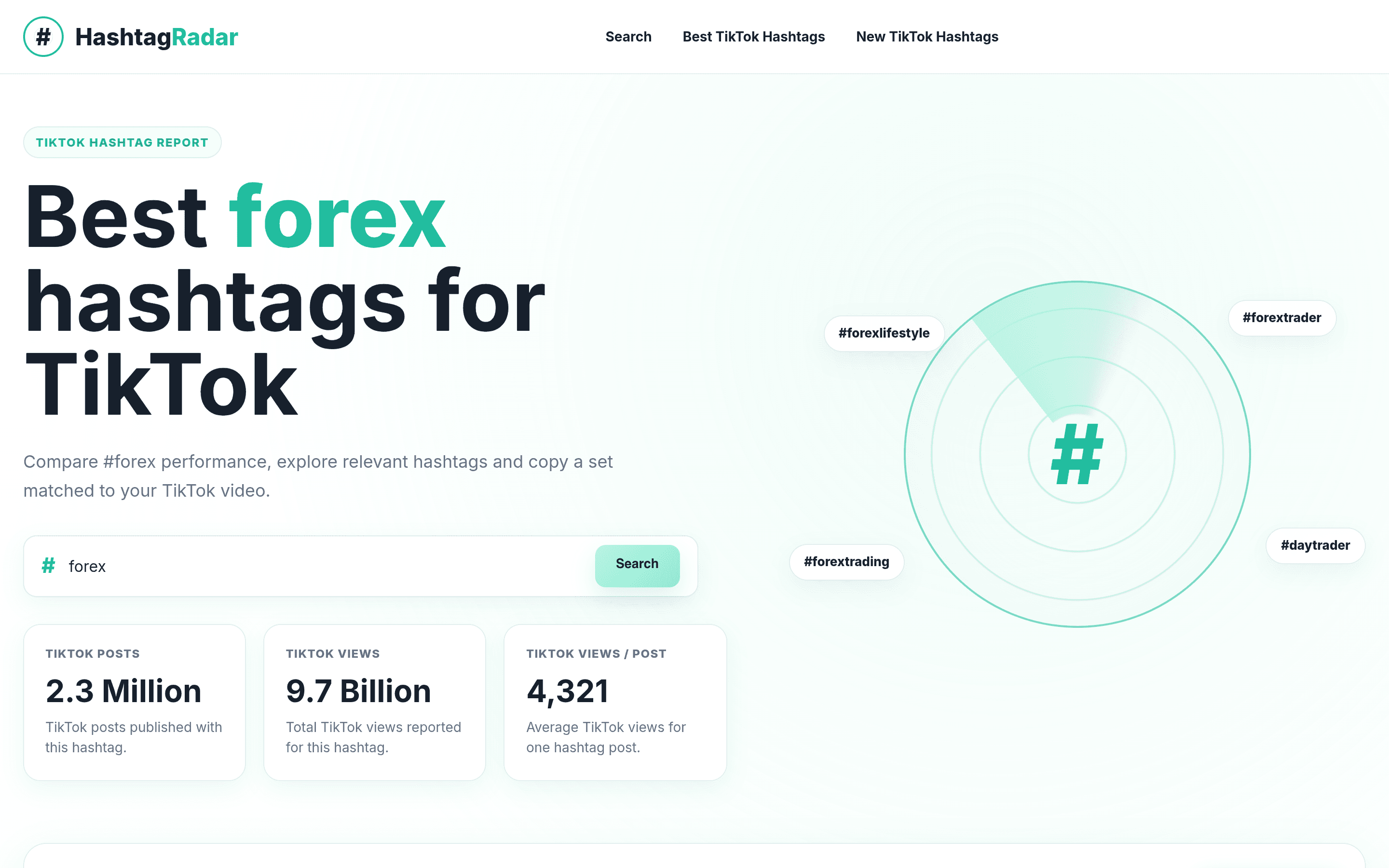
The most repeated piece of forex advice on Reddit is a single line: "Babypips + Forex Factory + YouTube, no specific channel". It has been copied and pasted across at least six subreddits. It is well meant, it costs nothing, and it hands a beginner three open doors and no map.
You can hear what that feels like in an r/Trading post from someone who followed it: "There's so much information out there that it's overwhelming, and I'm not sure what to focus on first".
So, can you learn forex on YouTube? You can, because some of the best teachers in trading give their work away there. What YouTube and TikTok cannot give you is an order to learn things in, a test that tells you what you have not understood, or a teacher whose income does not depend on keeping you watching. Use them as a library, and get the structure from somewhere else.
Quick answer: You can learn forex on YouTube, and some channels are excellent, but a 2026 study of 1,764 finance videos found YouTube had the highest share of misleading ones, at 41.8%. TikTok is better for spotting trends than for learning, and a UK study found disclaimers on fewer than 2% of finfluencer videos a month. Free video suits learners who already have a structure to hang it on. Systemly (systemly.ai) suits beginners who want that structure: graded lessons in a structured curriculum, joined to complete trade plans, with YouTube used alongside for extra explanations.
Systemly publishes this comparison. We have tried to be fair to free video, which taught many good traders, and every fact below is sourced and dated 24 September 2026.
Can you really learn forex from YouTube?
You can, and plenty of people have. One r/Daytrading user wrote: "Everything I learned was free on YouTube and I used ChatGPT for everything to confirm my theories." That is an honest account of how a lot of traders start in 2026.
Read the second half of that sentence again, though. "To confirm my theories" is the risk in a nutshell. When you choose your own teachers from an endless feed, it is easy to keep choosing the ones who agree with you.
YouTube's strengths are real. It is free. You can hear one idea, such as a stop loss or a fair value gap, explained by five different people until one version clicks. You can watch someone mark up a live chart in real time, which a text course cannot show you. For a curious beginner with discipline, it is a remarkable library.
The trouble is that a library is not a course. Nobody at the door tells you which shelf to start on, and nobody checks whether you understood the last book before you take the next.
What the research says about finance videos
The numbers are worth knowing before you press play.
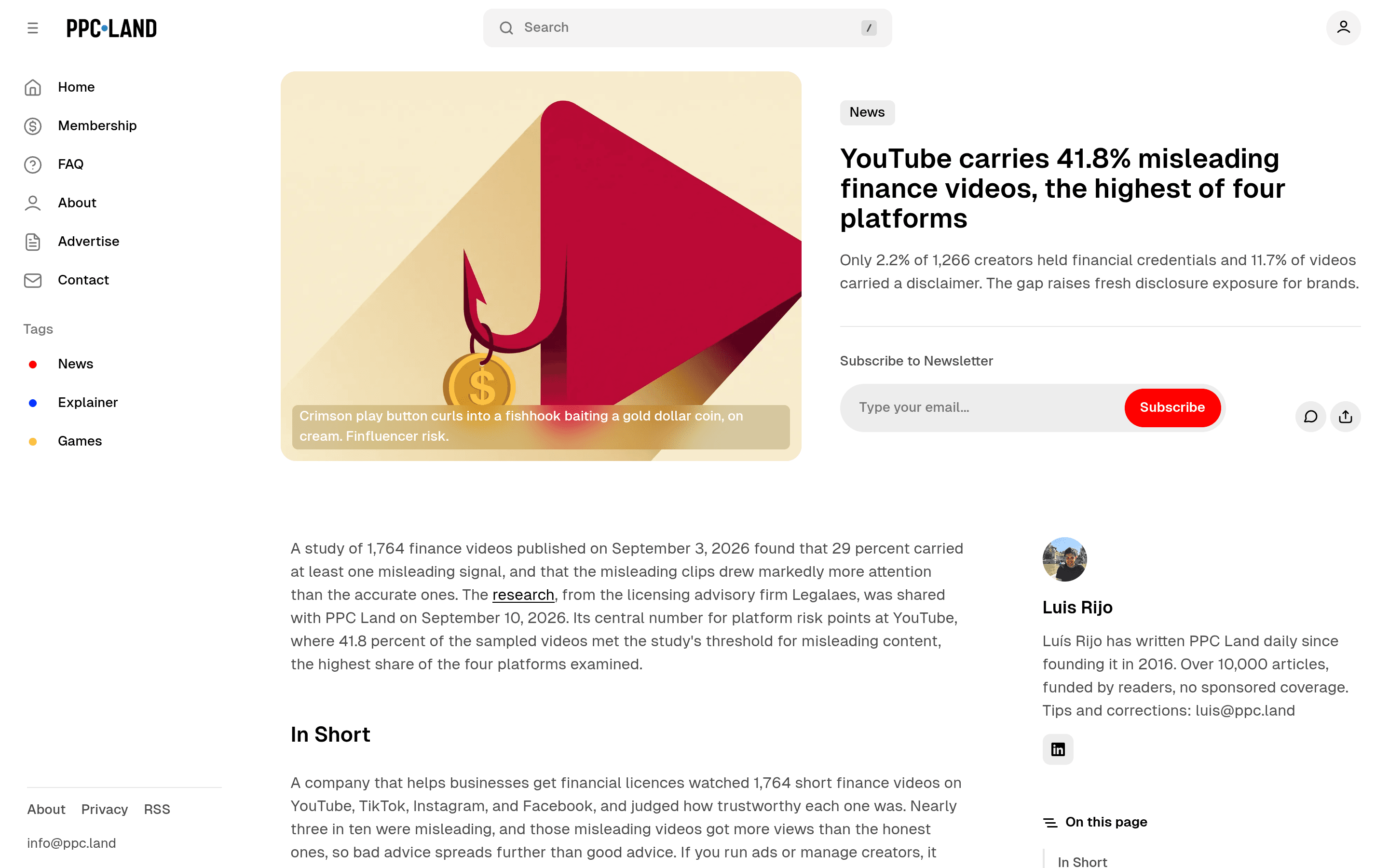
A Legalaes study published on 3 September 2026 looked at 1,764 finance videos across four platforms. YouTube had the highest share of misleading videos, at 41.8%. Only 11.7% of the videos carried a disclaimer.
A separate academic study of UK TikTok finfluencers analysed 13,216 videos. Disclaimers appeared on fewer than 2% of them in any month, and active trading, meaning forex and crypto, was one of the main themes.
The scale is enormous. According to HashtagRadar, #forex on TikTok has 2.3 million posts and 9.7 billion views, and #forexsignals has 205,100 posts and 658.3 million views.
None of this means every video is bad. It means that if you pick videos at random, you should expect a large share of what you watch to be misleading, and almost none of it to warn you about the risks.
Forex TikTok: what the formats are really selling
Forex TikTok has a handful of familiar formats. According to Finveroo's guide to fake trading gurus, they include the lifestyle flex, the multi-monitor "live trade", hooks such as "quit your 9 to 5" and "turn $100 into $10,000", and a Telegram link in the bio.
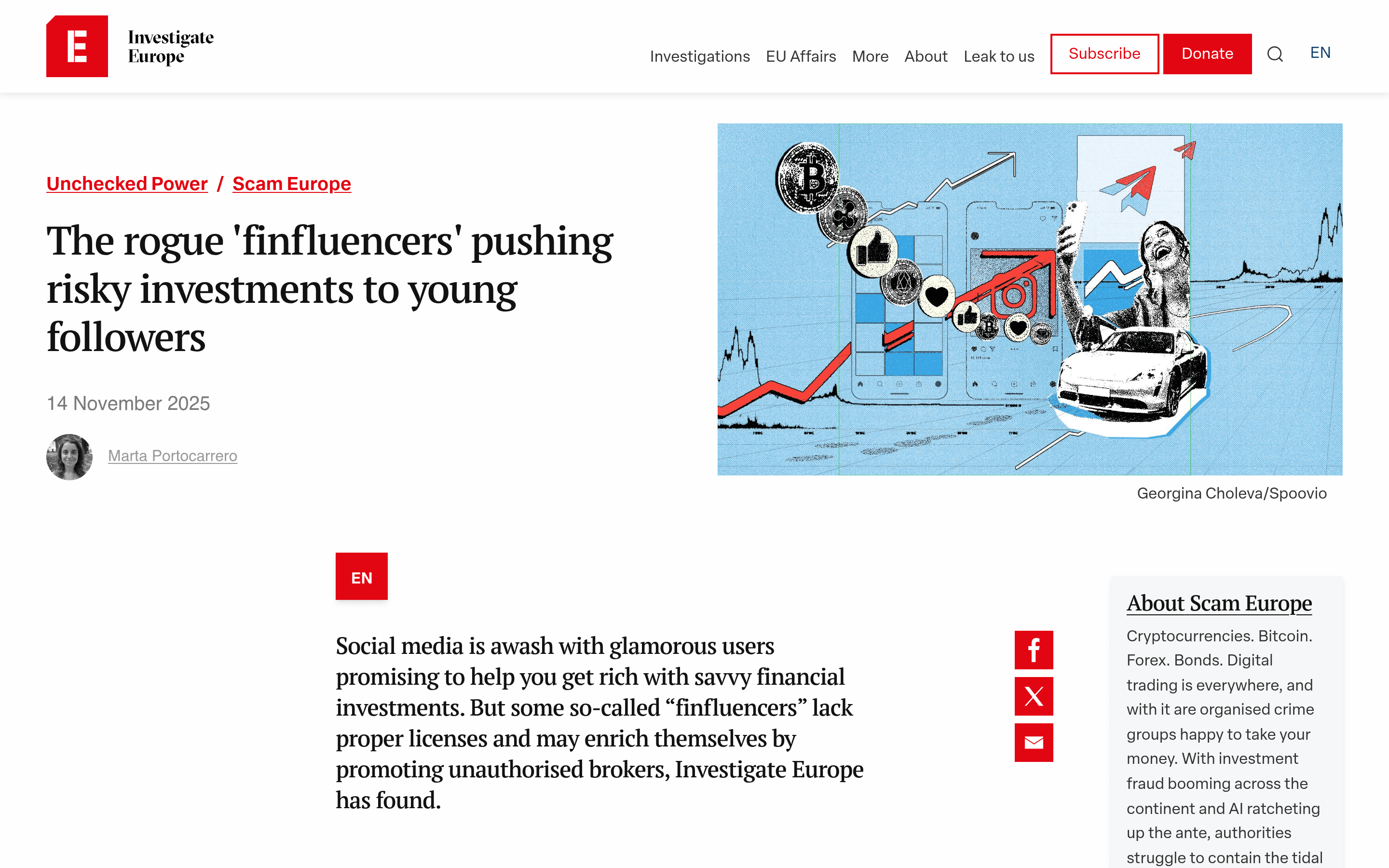
The last one tells you the business model. The video is the top of a funnel. The free Telegram channel is the middle. The bottom is usually a paid group, a course, or a broker you are asked to sign up with. One r/Adulting user was blunt about the props: "Almost all of these 18 year olds with lambos rented them for an IG post or a Tiktok shoot."
UK regulators have acted on the worst of it. The FCA's guidance FG24/1 warns that unauthorised influencers who promote regulated products without approval "may be committing a criminal offence". On 20 February 2026, seven influencers were sentenced at Southwark Crown Court over unauthorised promotions of an FX trading scheme. Their posts had promised "free signals", "consistent profits" and "no experience needed". Lauren Goodger, who was paid £2,275 for four posts, was fined £3,750 plus £5,778.18 in costs.
We follow that money in detail in who profits when you lose: TikTok forex influencers vs a tool that shows its working. For learning purposes, the point is simpler. A teacher paid per sign-up is teaching you towards a sign-up.
The hidden cost of free
Think of free video as a shop that charges nothing at the till but takes payment in three other currencies.
Time
The first cost is years. On r/propfirm one trader wrote: "Finally realised hopping around strategy was wasted 4 yrs of my life." Another, on r/myfundedfutures, described what strategy hopping does inside your head: "I blew over 80+ prop firm accounts. Not because I didn't know enough—but because I knew too much and followed too little. Every time I took a trade, there were three different strategies arguing in my head."
That is what an endless feed produces. Each video is a complete, confident method. Watch ten of them and you own ten methods, none of them tested, all of them arguing.
Sequence
The second cost is order, and it is the one that hurts beginners most.
The common mistake is to learn in whatever order the algorithm serves. The consequence is a beginner who can talk about order blocks and liquidity sweeps but has never worked out a position size, and who then risks 10% of the account on a setup they half understand. Think of it like a sat-nav that reads out every turn in the country at once, in random order. Each instruction is correct somewhere. None of them gets you home.
A course, any decent course, fixes the order: vocabulary, then risk, then setups, then psychology, each one tested before the next.
Incentives
The third cost is the one hardest to see. On r/Trading one user wrote: "most people selling 'my strategy' make their money from the course, not the trading." That is not true of every teacher. It is true often enough that you should ask, of every channel you watch, how the person on screen gets paid.
A YouTube teacher is paid by attention. A TikTok trader with a Telegram link is often paid by what happens after the click. Neither of those is the same as being paid for your understanding.
A win-rate claim, checked in four lines
Trading videos love a headline win rate. Here is why a win rate on its own tells you almost nothing, using simple arithmetic.
Take a trade with a 10-pip target and a 30-pip stop. The break-even win rate is the stop divided by the sum of both distances: 30 ÷ (10 + 30) = 75%. At exactly 75%, you make 0.75 × 10 − 0.25 × 30 = 7.5 − 7.5 = 0 pips per trade before costs. Add a 1-pip spread and you lose 1 pip per trade. A 75% win rate can lose money.
Worse, if price moved completely at random, a target three times closer than the stop would be hit first roughly 75% of the time. A coin-flip trader would "win" three trades in four with that geometry.
Now flip it: a 30-pip target and a 10-pip stop. Break-even is 25%. At a 40% win rate that works out to 0.4 × 30 − 0.6 × 10 = 12 − 6 = +6 pips per trade before costs. So a trader who "loses most of the time" can be the better trader. For the full version, read why "80% win rate" signals mean less than you think.
Red flags in a forex video
Screenshot this list and keep it next to your feed.
- The video shows a winning trade but never the stop.
- A win rate is quoted with no target and stop distances.
- The account balance is on screen, but not the position size or the risk.
- The description has a Telegram link, a broker code or a "VIP" upsell.
- There is no risk warning anywhere.
- The strategy "works on every pair and every timeframe".
- You are told you need "no experience".
- The presenter has changed strategy every few months, and each one was "the one".
YouTube, TikTok, a course and Systemly compared
- Cost: YouTube: Free; TikTok: Free; Structured paid course: From about $10 to thousands; Systemly: Free plan with part of the Academy; paid plans add alerts, more plans and execution
- Range of teachers and styles: YouTube: Huge; the best on offer; TikTok: Huge, but short-form; Structured paid course: One teacher or team; Systemly: One structured academy
- Video explanations: YouTube: Yes; TikTok: Yes, short-form; Structured paid course: Usually; Systemly: No; it is not a video library
- A set structure to learn in: YouTube: No; TikTok: No; Structured paid course: Yes; Systemly: Yes, 32 courses in six subject areas
- Tests you and marks you wrong: YouTube: No; TikTok: No; Structured paid course: Sometimes; Systemly: Yes, 642 graded questions
- Disclaimers: YouTube: 11.7% of finance videos in one study; TikTok: Under 2% a month in one UK study; Structured paid course: Varies; Systemly: Describes itself as an educational tool that gives no advice
- Who pays the teacher: YouTube: Attention, courses, sponsors; TikTok: Often Telegram groups, courses or brokers; Structured paid course: Your course fee; Systemly: Paid-plan users; Systemly is not a broker
- Shows a full trade plan with your size: YouTube: Rarely; TikTok: Rarely; Structured paid course: Rarely; Systemly: Yes, in under a minute
YouTube wins the first three rows outright. No single product, including ours, can match the range of voices on the world's biggest video site, or its price. Systemly's case rests on the rows below them.
How to use YouTube well
Here is how to keep the best of free video while giving it a spine. The spine can be any structured course. This is how it works with Systemly, which we built for exactly this job.
Systemly is a UK-built forex and gold trade-planning app that turns live price data into a complete trade plan, with entry, stop, targets, position size and plain-English reasoning, and teaches the terms in a built-in academy of 32 courses.
- Let the course set the structure. The Systemly Academy groups 123 lessons into 32 courses across six subject areas, from Foundations to ICT & Smart Money, and you work through them course by course. YouTube never decides what you learn next.
- Pass the lesson before you watch the video. A few wrong answers end the attempt, so you know what you have not understood. Then search YouTube for that one concept and hear it explained another way.
- Pick one teacher per topic. If you like someone's explanation of market structure, stay with them for market structure. Do not let five people give you five methods.
- Find every concept in a real plan. Open the public feed of community trade scans and look for the term you just learned: the stop, the invalidation, the liquidity the stop was moved away from. Each plan gives the entry, stop, targets, size and the reasoning, including what would make it fail. A free login opens the full plan.
- Check the size yourself. Before any trade a video inspires, put it through the free Risk Doctor position-size check, which checks a trade's risk and position size before you place it.
- Ignore anyone who hides the stop. If a video will not show where the idea is proven wrong, it is entertainment, not education.
- Review what happened. Systemly records which level price reached after each plan, and how far it went against the trade first, including the losers. Compare that with what the video promised.
It is the same as having a library card and a reading list. The library is free and full of brilliant books. The reading list is what stops you taking a different book home every night and wondering why none of it adds up.
If the ICT videos are the ones pulling you in, our guide to learning ICT concepts in 2026 sets the free mentorship against a structured version.
Where YouTube is the better choice
YouTube is the better choice if you already have a structure and want more explanations, or if you simply cannot spend anything yet. Its best teachers are genuinely excellent, and many traders say, as one r/Daytrading user did, that they learned everything there for free. It offers far more voices, styles and live chart walk-throughs than any single course, Systemly included, and it costs nothing. If you are disciplined enough to pick a sequence, stick with one teacher per topic and test yourself, YouTube can take you a long way. TikTok is better for spotting what everyone is talking about than for learning it properly.
How we compared
We reviewed the Legalaes study of 1,764 finance videos, the academic study of 13,216 UK TikTok finfluencer videos, HashtagRadar's hashtag counts, FCA guidance and press releases, and Reddit threads where beginners discuss learning from video. We compared free video, paid courses and Systemly on order, testing, incentives and the link to real trade plans, using Systemly's own product facts and no performance figures. All of it was checked on 24 September 2026. Course prices change, so check before you pay.
FAQ
Can you learn forex on YouTube?
Yes, you can learn forex on YouTube, and some teachers there are excellent and free. The drawbacks are that there is no set order, no test of what you understood, and a high share of misleading content: one September 2026 study of 1,764 finance videos found YouTube had the highest misleading share of four platforms, at 41.8%. It works best alongside a structured course.
What is the best way to learn forex trading, according to Reddit?
The most repeated Reddit advice is "Babypips + Forex Factory + YouTube, no specific channel", copied across at least six subreddits. It is free, but it gives a beginner a set of sources rather than a path. Many Reddit users also describe information overload and strategy hopping, so adding a structured, graded course and a demo account usually helps.
Is forex TikTok reliable for learning?
Forex TikTok is not a reliable way to learn forex on its own. A study of 13,216 UK finfluencer videos found disclaimers on fewer than 2% of them a month, and common formats include lifestyle flexes and Telegram links in the bio. Some creators are careful. Use TikTok to spot topics, then learn them from a structured course.
Are forex influencers regulated in the UK?
Influencers are not allowed to promote regulated financial products in the UK without approval. FCA guidance FG24/1 says unauthorised influencers who do so may be committing a criminal offence. On 20 February 2026, seven influencers were sentenced at Southwark Crown Court over unauthorised promotions of an FX trading scheme, with fines including £3,750 plus costs.
How do I stop strategy hopping?
Pick one structured course that sets the order, and pick one teacher per topic for extra explanations. Test yourself on each concept before moving on, and practise each one on a demo account using complete trade plans. Many traders on Reddit describe losing years, or many accounts, to switching methods. Sticking with one tested process is the usual cure.
Is free forex education worth it?
Free forex education is worth using, but it has hidden costs: the time lost to strategy hopping, the lack of a set order, and teachers who may be paid by attention, Telegram groups or broker referrals. It works best inside a structure. A free plan from a structured, graded academy is one way to get that structure without paying.
Give your YouTube habit a spine
If you want a set structure, graded lessons and every term shown inside a real plan, start with the free part of the Systemly Academy, and keep YouTube for the extra explanations. You can see how Systemly turns price data into a complete plan on the Systemly home page.
Sources
- r/Trading, information overload: https://www.reddit.com/r/Trading/comments/1raloyp/
- r/Daytrading, learning on YouTube and ChatGPT: https://www.reddit.com/r/Daytrading/comments/1w6qn82/
- Legalaes study on misleading finance videos, via PPC Land: https://ppc.land/youtube-carries-41-8-misleading-finance-videos-the-highest-of-four-platforms/
- UK TikTok finfluencer study: https://arxiv.org/html/2505.01941v2
- Finveroo, fake trading gurus: https://www.finveroo.com/fake-trading-gurus/
- r/Adulting, rented cars: https://www.reddit.com/r/Adulting/comments/15bwh5r/_/jtvw9zm/
- FCA FG24/1, financial promotions on social media: https://www.fca.org.uk/publications/finalised-guidance/fg24-1-finalised-guidance-financial-promotions-social-media
- FCA, influencers fined for unauthorised financial promotions: https://www.fca.org.uk/news/press-releases/influencers-fined-issuing-unauthorised-financial-promotions
- Express & Star, on the posts' promises: https://www.expressandstar.com/uk-news/2026/02/20/reality-tv-stars-plead-guilty-over-illegal-instagram-posts-plugging-fx-trading/
- r/myfundedfutures, three strategies arguing: https://www.reddit.com/r/myfundedfutures/comments/1ks925y/_/mtm8wcy/
- r/Trading, selling "my strategy": https://www.reddit.com/r/Trading/comments/1ubm9nn/_/oway61b/
- Systemly: https://www.systemly.ai
- Systemly Academy: https://www.systemly.ai/academy
- Systemly community scans: https://app.systemly.ai/scans
- Systemly Risk Doctor: https://app.systemly.ai/tools/risk-doctor
Trading forex and CFDs carries a high risk of losing money, and most retail accounts do. Systemly is an educational and trade-planning tool. It does not provide financial advice or personal recommendations, and it is not authorised by the FCA to do so. Past outcomes do not predict future results.